
Business Manager Visa Japan: Tax Strategy & ISA Compliance Guide for Foreign Entrepreneurs | TaxMatch Japan
The Business Manager Visa and Japanese tax law have fundamentally conflicting incentives — and most foreign business owners don’t discover this until visa renewal time. Here’s how to navigate both systems without sacrificing your immigration status.
Business Manager Visa holder with Japan tax questions? Get matched with a specialist who handles both — free.
Get Matched Free →Japan’s Business Manager Visa (経営管理ビザ) is designed for foreign nationals who operate their own incorporated business in Japan. At the point of renewal, the Immigration Services Agency (ISA) evaluates whether your business is genuinely viable and whether you are legitimately managing it. This evaluation relies heavily on your financial statements — the same statements that your tax optimization strategy may have made look as unfavorable as possible.
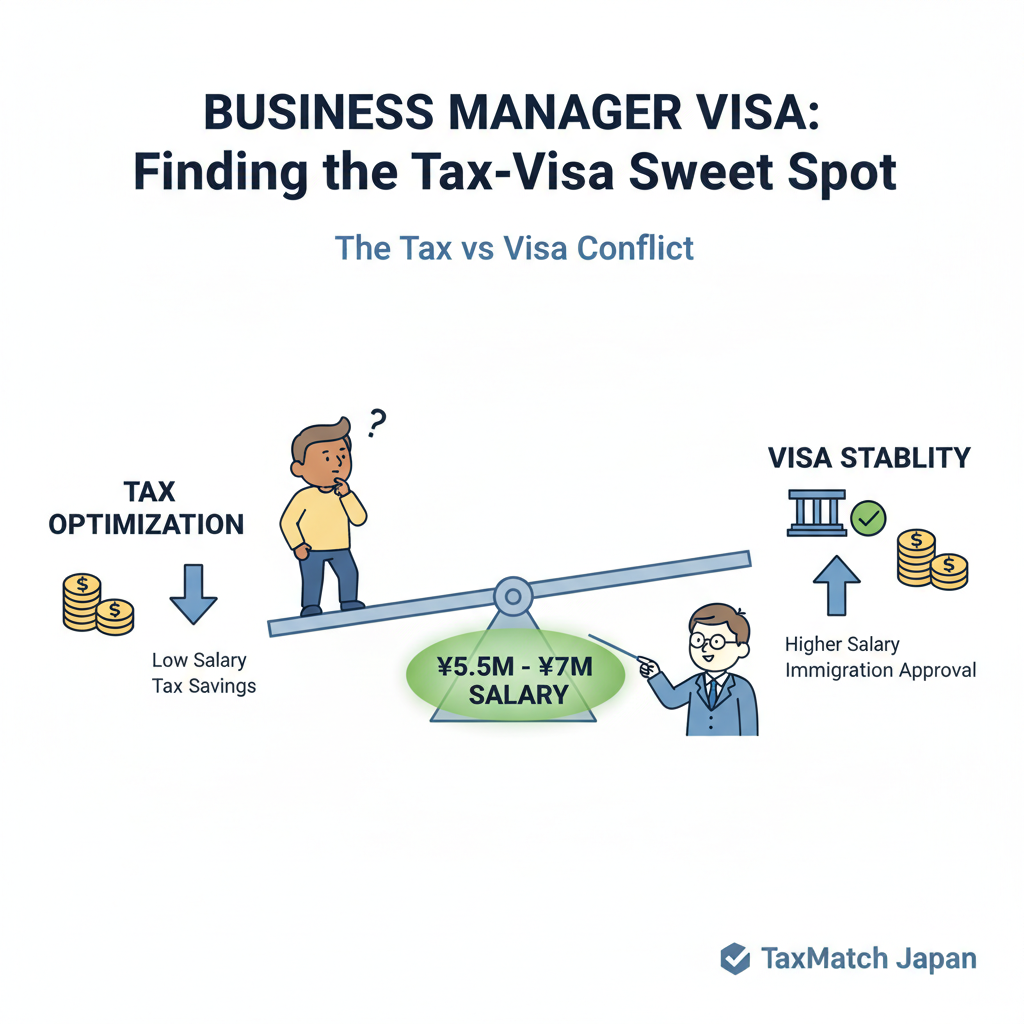
Business Manager Visa: Finding the tax-visa sweet spot
Visa Requirements: Before and After October 2025
| Requirement | Before October 2025 | After October 2025 |
|---|---|---|
| Minimum capital | ¥5,000,000 | ¥30,000,000 |
| Employees | At least 2 full-time employees (or equivalent) | At least 1 full-time employee |
| Office | Dedicated physical office required | Dedicated physical office required |
| Japanese language | Not required | JLPT N2 or equivalent (new applicants) |
| Grace period | — | 3 years for businesses established under old rules |
| Visa duration (initial) | 1 year (typical for new businesses) | 1 year (new businesses); 3 or 5 years for established |
⚠️ The ¥30M Capital Barrier for New Businesses
The October 2025 increase from ¥5M to ¥30M capital requirement has effectively closed the Business Manager Visa pathway for most new small business applicants. Entrepreneurs who established businesses before October 2025 under the old rules have a 3-year grace period. Alternatives that have emerged include:
- Startup Visa (スタートアップビザ): Available in select municipalities for up to 6 months; allows business planning and incorporation without meeting full BM visa requirements immediately
- Digital Nomad Visa (デジタルノマドビザ): For remote workers employed by overseas companies; allows up to 6 months in Japan; no Japanese tax resident obligations if stay is under the threshold
- Highly Skilled Professional Visa (HSP): For executives or researchers meeting the point-based system criteria; allows more flexible activities than standard work visas
How ISA Evaluates Business Manager Visa Renewals
At renewal time, the ISA examines whether your business demonstrates genuine, ongoing commercial substance. They primarily assess:
| Factor | What ISA Looks For | Risk Signal |
|---|---|---|
| Revenue and profitability | Consistent or growing revenue; profitable or showing a credible path to profit | Zero or near-zero revenue; consecutive losses; declining revenue trend |
| Director compensation | Salary consistent with legitimate business management | Zero salary; salary below minimum wage equivalent |
| Tax compliance | Regular tax filing; taxes paid; no outstanding obligations | Late filings; unpaid taxes; failure to file consumption tax returns |
| Social insurance | Enrollment in shakai hoken (health insurance + pension) for director and employees | Not enrolled; enrollment gaps |
| Business substance | Real office; real clients; real business activities evidenced by invoices and contracts | Virtual office only; no clients; no business documentation |
ISA’s Tiered Response to Financial Performance
| Business Financial Profile | Typical Visa Outcome |
|---|---|
| Profitable, growing revenue, adequate director salary, compliant | 5-year renewal (typically) |
| Stable or modest profit; adequate director salary; compliant | 3-year renewal |
| Low profit or slight loss; plausible business plan; director salary paid | 1-year renewal with explanation required |
| Consecutive losses; no director salary; minimal business activity | Renewal denial or 1-year with strict conditions |
| Non-compliance (unfiled taxes, social insurance gaps, no office) | High risk of denial; potential deportation proceedings |
The Core Conflict: Tax Optimization vs. Visa Viability
Here is the fundamental tension that trips up most foreign business owners in Japan:
⚠️ The Classic Tax Optimization Trap
A foreign business owner on a Business Manager Visa follows common tax advice:
- Set director salary to ¥0 or minimal amount → saves income tax and social insurance
- Expense everything through the company → reduces corporate profits
- Carry forward losses aggressively → minimizes current year tax
Result: tax return looks excellent (minimal tax owed). Visa renewal documents look terrible (zero salary + consecutive losses = no genuine business operation).
At the 3-year mark, ISA declines renewal. The owner loses their right to remain in Japan.
Why “Aggressive Expense” Strategies Backfire
Running excessive personal expenses through the company reduces corporate profit — which is great for corporate tax, but ISA sees it as evidence that the business is a shell designed to maintain a visa rather than a genuine commercial operation. ISA officers are specifically trained to identify patterns that suggest “business manager in name only.”
The Sweet Spot: Director Salary That Satisfies Both Systems
The key insight from experienced Japan immigration and tax professionals: the optimal director salary for Business Manager Visa holders is not zero, and not maximum. It is a carefully chosen amount that:
- Demonstrates genuine income from the business (visa credibility)
- Generates enough income tax liability to show the owner is a productive contributor to Japan’s economy
- Keeps total tax + social insurance burden at a manageable level
- Allows the company to remain profitable (or near profitable) at the corporate level
📌 The ¥5.5M–¥7M Director Salary Sweet Spot
For most Business Manager Visa holders, a director salary in the range of ¥5,500,000–¥7,000,000 per year achieves the best balance:
- Visa signal: This salary level shows genuine employment and management compensation (supports 3-year or 5-year renewal)
- Income tax: Effective combined rate of approximately 25-30% — substantial but not crushing
- Social insurance: Monthly standard remuneration is set for shakai hoken purposes; at ¥6M salary, total social insurance (employer + employee) is approximately ¥1.5-1.7M/year
- Corporate profit: With a reasonable salary, the company can show positive profit (taxed at 15-23%), which strengthens the visa renewal application
The exact optimal figure depends on your business’s revenue, expense structure, and planned future revenue. A tax accountant familiar with both corporate tax and immigration requirements can calculate the precise number for your situation.
Scenario Analysis: 4 Common Business Manager Situations
Scenario 1: New Startup (Year 1-2)
Situation: Revenue still building; company showing a loss in year 1. Director taking ¥4M salary.
Strategy: A loss in year 1 is acceptable if you have a credible business plan and documented client pipeline. Keep salary paid (even at lower level). File taxes and social insurance on time. Document all business activities — contracts, invoices, client communications. At year 1 renewal, proactively explain business trajectory with supporting documents. Aim for profitability by year 2 to support a longer renewal period.
Scenario 2: Established Profitable Service Business
Situation: ¥15M annual revenue, ¥10M net profit before director salary. Director considering whether to take ¥2M or ¥8M salary.
Strategy: ¥8M salary is likely optimal here. The company retains ¥2M profit taxed at ~23% corporate rate. Director pays income tax on ¥8M at approximately 30% effective rate. Total tax is lower than if all ¥10M were taken as salary. ISA sees ¥8M salary as strong evidence of genuine business management. High probability of 5-year renewal.
Scenario 3: Three-Year vs. One-Year Renewal Optimization
Situation: Coming up for renewal; business had one bad year out of three.
Strategy: Prepare an explanation letter (理由書) for the bad year with supporting documentation — a major client that left, market conditions, pandemic impacts, etc. Show that the business has recovered or has a credible recovery plan. ISA considers the trend, not just the most recent year. A one-year renewal with detailed documentation is often the outcome — use that year to demonstrate recovery for the next renewal application.
Scenario 4: E-Commerce or IP Business with Offshore Revenue
Situation: Running an e-commerce business with revenue flowing through overseas payment processors; concerned about Japan consumption tax and income declaration.
Strategy: All Japan-source revenue (sales to Japan consumers) must be declared for consumption tax purposes once revenue exceeds ¥10M. Foreign revenue may be subject to Japan tax if the company’s principal place of management is in Japan. Do not attempt to hide offshore revenue — Japanese companies’ worldwide income is taxed in Japan if effectively managed from Japan. Engage a tax accountant with e-commerce and transfer pricing experience before the business scales.
The Professional Silo Problem
⚠️ Tax Accountants and Immigration Lawyers Often Don’t Talk to Each Other
Your tax accountant optimizes for minimizing tax — and may suggest strategies that inadvertently undermine your visa. Your immigration lawyer optimizes for visa approval — but doesn’t review your financial statements with a tax optimization lens. Foreign business owners on the Business Manager Visa are frequently caught between contradictory advice from two professionals who have never spoken with each other about your specific situation.
The solution: find a tax accountant with explicit experience in Business Manager Visa holder situations — or an accountant and immigration lawyer who actively coordinate on your case. This coordination is not standard; you need to specifically request it.
Blue Form Tax Return for Corporations
Like sole proprietors, corporations can file under the 青色申告 (Blue Form) system for corporations. Key benefits:
- Loss carryforward for 10 years (vs. 3 years for individuals) — losses from early business years can offset future profits
- Accelerated depreciation for SME qualifying assets
- Various SME tax incentives including wage increase credits and IT investment deductions
File the Blue Form application within 3 months of incorporation (or within the first fiscal year) at your local tax office. This is a simple procedural step that should not be overlooked.
Annual Compliance Calendar for Business Manager Visa Holders
| Month | Tax Obligation | Immigration Consideration |
|---|---|---|
| Month 3 of fiscal year | Set (or adjust) director salary for the year — must be done before this deadline | Salary level affects visa renewal; set thoughtfully |
| 2 months after fiscal year end | Corporate tax return filing deadline | ISA may request this for renewal; file on time |
| March 15 (calendar year) | Personal income tax return (if applicable beyond 年末調整) | Personal tax compliance is checked at renewal |
| End of month 2 of social insurance cycle | Social insurance premium adjustments | Gaps in enrollment are a visa red flag |
| 3-6 months before visa expiry | Prepare renewal documents: 2-3 years of financial statements, tax payment certificates | Start early; gather 納税証明書 from tax office |
📝 Business Manager Visa + Tax Compliance Checklist
- Director salary set in the range of ¥5.5M–¥7M (or appropriate level for business size)
- Social insurance (shakai hoken) enrollment active and premiums current
- Corporate tax return filed on time (within 2 months of fiscal year end)
- Personal income tax return filed on time (March 15)
- Consumption tax filing current (if registered)
- Blue Form application filed for corporation
- Company showing profit or credible business trajectory — not consecutive losses
- Physical office maintained (not virtual address only)
- Tax accountant and immigration lawyer coordinated on your case
Business Manager Visa holder looking for integrated tax + immigration expertise?
TaxMatch Japan connects you with tax specialists who understand the visa compliance dimension of corporate tax strategy — completely free matching service.
Or reach us directly on LINE
This article is for informational purposes only and does not constitute tax, legal, or immigration advice. Business Manager Visa requirements and tax rules are complex and change regularly. Please consult a qualified licensed tax accountant (zeirishi) and a certified immigration specialist (行政書士) for personalized guidance specific to your situation.
Frequently Asked Questions
What is the Business Manager Visa in Japan?
The Business Manager Visa (keiei kanri visa) allows foreign nationals to start and manage a business in Japan. It requires an office in Japan, at least ¥5 million in capital investment or 2+ full-time employees, and a viable business plan.
How much capital do I need for a Business Manager Visa?
The standard requirement is ¥5 million (approximately $35,000) in capital investment. Alternatively, you can employ 2 or more full-time residents of Japan. The capital must be genuinely invested in business operations, not just held in a bank account.
What are the tax implications of a Business Manager Visa?
Business Manager Visa holders are tax residents of Japan and must pay income tax, residence tax, social insurance, and potentially consumption tax. Your company pays corporate tax (approximately 23-30%). Proper tax planning between personal and corporate taxes is essential for optimizing your total tax burden.