Freelancer Tax in Japan: Complete Guide for Foreign Self-Employed Residents (2026)
Working as a freelancer in Japan? Here’s everything you need to know about taxes, deductions, and staying compliant — from opening your business to filing your return.
Quick Summary: Freelancer Tax in Japan
- First step: Submit an Opening Notification (開業届) within 1 month + apply for Blue Return
- Blue Return deduction: Up to ¥650,000 off your taxable income (requires double-entry bookkeeping + e-Tax)
- Invoice system: Since Oct 2023, clients may demand you register — the “2026 cliff” makes this urgent
- Social insurance: National Health Insurance + National Pension = ~15% of income + fixed premiums
- Visa: No “freelance visa” exists — you need a self-sponsorship scheme with domestic clients
Read on for the full guide to legally operating and optimizing your taxes as a freelancer in Japan.
Table of Contents
- Getting Started: Opening Notification & Blue Return
- Blue Return vs. White Return: Why It Matters
- Deductible Expenses for Foreign Freelancers
- The Invoice System: What Freelancers Must Know
- National Health Insurance & Pension
- Overseas Income & Double Taxation
- Visa Requirements for Freelancers
- When to Hire a Tax Professional
Freelancing in Japan and need tax help? We’ll match you with a bilingual tax accountant — free.
Get Matched Free →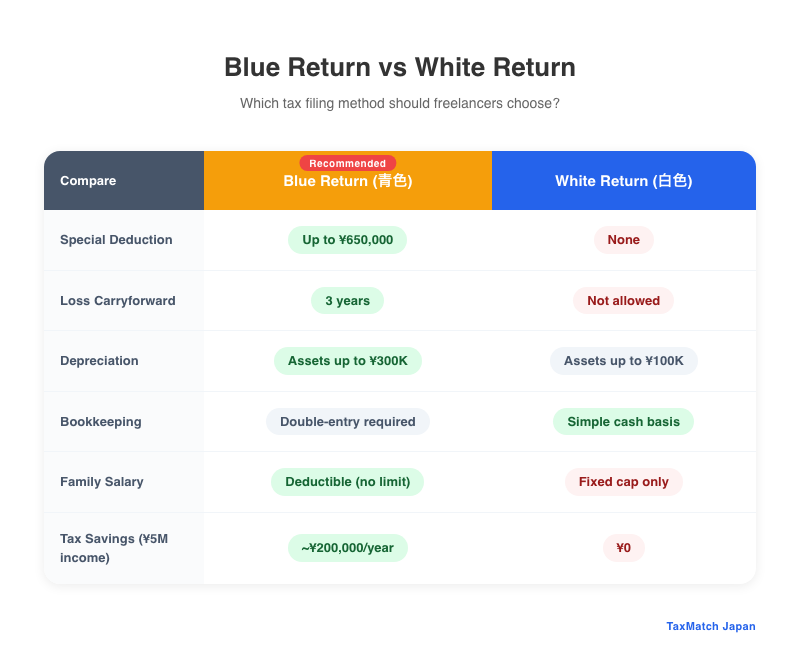
Blue Return vs White Return: Which should you choose?
Getting Started: Opening Notification & Blue Return
When you start freelancing in Japan, two documents must be submitted to your local tax office — and the timing is critical.
1. Opening Notification (個人事業の開業届出書)
Submit within 1 month of starting your business. You can do this via e-Tax using your My Number Card (recommended — you’ll get an instant electronic receipt) or on paper at the tax office.
2. Application for Blue Return Approval (青色申告承認申請書)
This is the single most important tax document for freelancers. Submit it:
- If starting a new business after January 16: within 2 months of your start date
- If switching from White to Blue Return: by March 15 of the year you want it to apply
⚠️ Miss the Deadline by Even 1 Day = White Return for the Entire Year
If you miss the Blue Return application deadline, you’re stuck with a White Return for that fiscal year. The difference can easily be ¥100,000+ in extra taxes. Submit both documents together on day one.
Blue Return vs. White Return: Why It Matters
Japan’s tax filing system has two tiers. The Blue Return (青色申告) offers powerful tax benefits — but requires proper bookkeeping.
| Feature | White Return | Blue Return (Max) |
|---|---|---|
| Special deduction | ¥0 | ¥650,000 |
| Bookkeeping required | Single-entry (simple) | Double-entry |
| Financial statements | Income statement only | Income statement + Balance sheet |
| Filing method | Any | Must use e-Tax (for ¥650,000; paper = ¥550,000) |
| Loss carryforward | Not available | 3 years |
| Small asset expensing | ¥100,000 threshold | ¥300,000 (full deduction in purchase year) |
| Family employee salaries | Not deductible | Fully deductible (with prior notification) |
To qualify for the full ¥650,000 deduction, you must meet all five requirements:
- Your income is classified as business income
- You maintain double-entry bookkeeping records
- You attach both an income statement and balance sheet
- You file by the deadline (March 15)
- You file via e-Tax (or use electronic book preservation)
📌 The ¥650,000 Deduction Saves More Than Just Income Tax
In Japan, National Health Insurance premiums are calculated based on your declared income. A ¥650,000 deduction doesn’t just reduce your income tax — it also lowers your NHI premiums by roughly ¥100,000 per year. The Blue Return is the single most powerful legal tax optimization available to freelancers.
Deductible Expenses for Foreign Freelancers
As a freelancer, you can deduct business expenses from your revenue before calculating tax. The key rule: the expense must be directly necessary to earn your business income.
Common deductible expenses:
| Expense Category | Examples | Notes |
|---|---|---|
| Outsourcing costs | Subcontractor fees, designer/developer costs | Full amount |
| Communication costs | Phone bill, internet, domain fees | Business portion only |
| Rent (home office) | Portion of apartment rent | Pro-rate by room area (typically 10-40%) |
| Utilities (home office) | Electricity, gas | Pro-rate by working hours or area |
| Equipment | Computer, monitors, desk, chair | Under ¥300,000 = full deduction in year 1 (Blue) |
| Software / subscriptions | Adobe, AWS, accounting software | Full amount if business-use |
| Travel | Train, taxi, domestic flights for client meetings | Keep receipts and records |
| Advertising | Google Ads, business cards, portfolio site | Full amount |
| Professional fees | Tax accountant, lawyer | Full amount |
Foreigner-specific expenses to be careful with:
⚠️ Home Country Flights: Usually NOT Deductible
Flights home are only deductible if the primary purpose is business (client meetings, conferences). The NTA calculates a “business engagement ratio” — if less than 10% of your trip days are spent on work, the entire airfare is denied. Keep meeting minutes and email records as proof if claiming.
⚠️ Japanese Language School: Generally NOT Deductible
Language learning is considered personal improvement, not a direct business expense. Exception: if you took a specialized course (e.g., IT terminology in Japanese) that directly led to a specific contract, it may qualify — but you’ll need strong documentation.
The Invoice System: What Freelancers Must Know
Since October 2023, Japan’s Qualified Invoice System (インボイス制度) has changed the game for freelancers doing B2B work.
The problem: If you’re a tax-exempt business (annual sales under ¥10 million), you cannot issue qualified invoices. This means your corporate clients cannot deduct the consumption tax on payments to you — making you more expensive to work with.
Your two choices:
| Option | Pros | Cons |
|---|---|---|
| Stay tax-exempt (don’t register) | No consumption tax to pay | Clients may reduce your pay by ~10% or stop ordering |
| Register as invoice issuer | Clients can deduct tax normally | You must pay ~10% consumption tax + file consumption tax returns |
⚠️ The “2026 Cliff” Is Coming
Currently, companies can still deduct 80% of consumption tax on purchases from unregistered freelancers. But from October 2026, this drops to 50%. From October 2029, it’s 0%.
If most of your work is B2B with Japanese companies, registering for invoices by late 2026 is becoming unavoidable.
Good news for new registrants: The “20% Special Rule” lets you pay only 20% of the consumption tax you collected (effectively getting an 80% deduction), with no complex calculations required. This applies through September 2026.
National Health Insurance & Pension
As a freelancer, you don’t have an employer to split costs with. You’re responsible for the full amount of:
1. National Health Insurance (国民健康保険)
Premiums are calculated by your municipality based on your previous year’s income. The formula varies by city, but typically includes:
- A flat per-household amount
- A flat per-person amount
- An income-based rate of roughly 15% of your income (combined medical + support + nursing care portions)
📌 Blue Return = Lower NHI Premiums
The ¥650,000 Blue Return deduction reduces your “previous year’s income” for NHI calculation purposes. At a ~15% income rate, that’s roughly ¥100,000 saved on health insurance alone — on top of your income tax savings.
2. National Pension (国民年金)
A flat monthly premium regardless of income: ¥17,510/month in FY2025 (~¥210,000/year). Prepaying one or two years in advance gets you a small discount.
Social Security Agreements: If your home country has a Social Security Agreement with Japan (US, Germany, UK, Australia, and 19 others), you may be exempt from Japan’s pension to avoid paying into two systems. Get a “Certificate of Coverage” from your home country’s social security agency and submit it to the Japan Pension Service.
Overseas Income & Double Taxation
A critical misconception among foreign freelancers: “I work for overseas clients, so my income isn’t taxed in Japan.”
⚠️ Where You Work Determines Where It’s Taxed
If you physically perform the work in Japan (at home, at a cafe, anywhere in Japan), the income is Japan-sourced and taxable in Japan — even if the client is overseas and pays into your foreign bank account.
If both Japan and your home country tax the same income, you can use the Foreign Tax Credit when filing your Japanese return to deduct the tax paid overseas. Japan has tax treaties with 80+ countries to prevent double taxation.
Non-Permanent Residents (lived in Japan ≤ 5 years): Foreign-sourced income that is not remitted to Japan is exempt. But remember — using an overseas credit card in Japan counts as “remitting” funds.
Visa Requirements for Freelancers
There is no “freelance visa” in Japan. Most foreign freelancers use the “Engineer / Specialist in Humanities / International Services” visa under a self-sponsorship arrangement.
Key requirements for visa renewal as a self-sponsored freelancer:
| Requirement | Details |
|---|---|
| Domestic clients | You must have continuous contracts with companies in Japan. Overseas clients only = visa denial. |
| Stable income | Generally ¥200,000–250,000+/month from domestic clients. Proven by your tax return. |
| Main sponsor | One domestic client must be designated as your “affiliated organization” and stamp your visa application. This is the biggest hurdle. |
| Tax compliance | Filed tax returns, paid resident tax — immigration checks this carefully. |
📌 Alternative: Business Manager Visa
If you can’t find a main sponsor, you may need a “Business Manager” visa — which requires either ¥5 million in capital or 2+ full-time employees, plus a dedicated office. Some cities (like Sapporo) offer a Startup Visa program with a 6–12 month preparation period and free support to help foreign entrepreneurs meet these requirements.
When to Hire a Tax Professional
You should strongly consider working with a tax accountant if:
- You’re setting up your Blue Return and double-entry bookkeeping for the first time
- You need to decide whether to register for the Invoice System
- You have income from both Japanese and overseas clients
- You need to apply the Foreign Tax Credit
- You’re preparing for a visa renewal and need clean tax records
- Your annual business income exceeds ¥5 million
Need a Tax Accountant Who Understands Freelancers?
TaxMatch Japan connects you with bilingual tax professionals who specialize in sole proprietors and freelancers — including Blue Return setup, invoice registration, and overseas income handling. Matching is completely free.
We typically respond within 24 hours.
Frequently Asked Questions
How are freelancers taxed in Japan?
Freelancers in Japan pay income tax (5-45%), reconstruction surtax (2.1% of income tax), residence tax (approximately 10%), and consumption tax (if annual revenue exceeds ¥10 million). Freelancers must file an annual tax return (kakutei shinkoku) between February 16 and March 15.
What is a Blue Return in Japan?
The Blue Return (aoiro shinkoku) is a special tax filing status that offers significant benefits including a ¥650,000 special deduction, the ability to carry forward losses for 3 years, and the option to deduct salaries paid to family members. You must apply in advance and maintain proper bookkeeping records.
What expenses can freelancers deduct in Japan?
Deductible business expenses include: office rent (or home office portion), equipment and supplies, transportation, communication costs, professional development, insurance, depreciation of assets, and subcontractor fees. A home office deduction is calculated based on the percentage of your home used for business.
Disclaimer
This article is for informational purposes only and does not constitute tax, legal, or financial advice. Tax laws and regulations are subject to change. The invoice system transitional measures, social insurance rates, and visa requirements described here reflect our understanding as of early 2026. Individual situations vary — always consult a qualified tax professional (税理士) and immigration specialist for your specific case. TaxMatch Japan is a matching service and does not provide tax advice directly.