Furusato Nozei for Foreigners in Japan: The Complete Guide (2026)
Imagine getting premium wagyu beef, bags of rice, craft beer, and high-end kitchen appliances — all for a flat cost of 2,000 yen. That is essentially what furusato nozei (ふるさと納税) offers every taxpayer in Japan, including foreigners on any visa type. Yet most non-Japanese residents have never heard of it. This guide walks you through everything: how it works, who qualifies, the income-based donation limits, which platforms to use, and the common mistakes that can cost you real money.
Important Notice
This article is for general informational purposes only and does not constitute tax, legal, or financial advice. Tax rules and rates may change. Always consult a qualified tax professional (zeirishi) for advice specific to your situation.
Need a bilingual tax accountant? Get matched with a specialist — free.
Table of Contents
- What Is Furusato Nozei?
- How It Works (Step by Step)
- Who Can Use Furusato Nozei?
- The January 1st Rule (Critical for Foreigners)
- Donation Limits by Income
- The One-Stop Exception (ワンストップ特例制度)
- Filing via Kakutei Shinkoku (確定申告)
- Best Platforms for Foreigners
- Best Value Strategy
- Common Traps to Avoid
- How to Verify Your Tax Credit
- Furusato Nozei Checklist for Foreigners
- When You Need Professional Help
- Frequently Asked Questions
How Furusato Nozei works: 6 steps
1. What Is Furusato Nozei?
Furusato nozei (ふるさと納税) literally translates to “hometown tax donation.” The Japanese government created it in 2008 to help rural municipalities compete for tax revenue against Tokyo and other big cities. The system lets you redirect part of your residence tax to any municipality of your choice — and in return, that municipality sends you a thank-you gift worth up to 30% of your donation amount.
Here is the key: your donations are credited against your income tax and residence tax the following year. After accounting for a flat 2,000 yen self-pay amount, the rest comes back as tax credits. You are not paying extra tax. You are just choosing where part of your existing tax goes — and getting gifts for doing it.
In plain English: You pay 2,000 yen out of pocket, get tens of thousands of yen worth of local specialty products, and the rest is deducted from taxes you would have paid anyway.
2. How It Works (Step by Step)
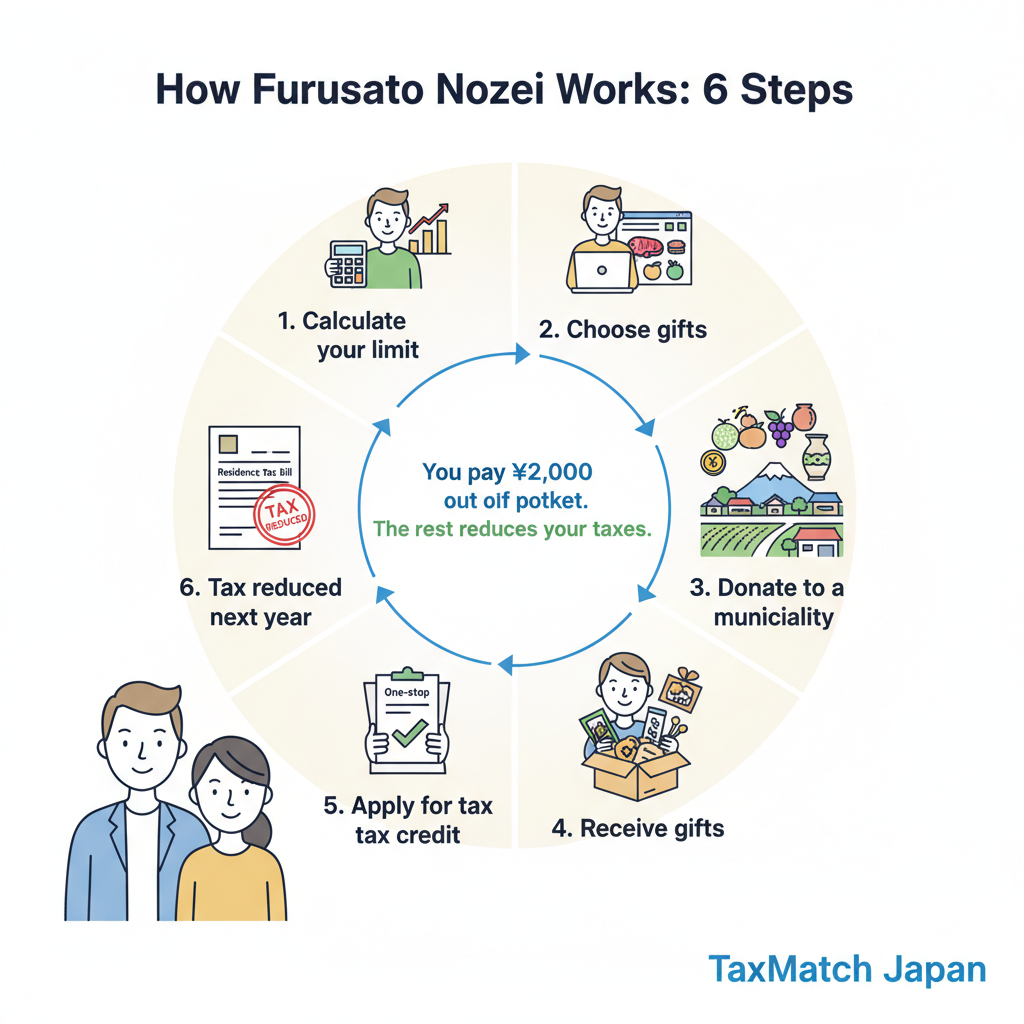
- Calculate your donation limit based on your income (see the table below)
- Choose a municipality and gift on a furusato nozei portal site
- Pay via credit card, convenience store, or other methods
- Receive the gift — usually within 1-8 weeks
- Claim the tax credit via the One-Stop Exception or your annual tax return
- Your taxes decrease the following June by your total donations minus 2,000 yen
Example: You earn 5,000,000 yen per year and donate a total of 61,000 yen across several municipalities. You receive gifts worth roughly 18,300 yen (30% of 61,000). The following June, your residence tax drops by 59,000 yen (61,000 minus the 2,000 yen self-pay). Your effective cost for 18,300 yen worth of premium products: 2,000 yen.
You can split your donations across multiple municipalities and receive gifts from each one. Many people make 5-10 separate donations throughout the year.
A tax professional can help you optimize Furusato Nozei and other deductions.
Maximize Your Tax Savings — Free Consultation →
Free matching · No obligation · English support
3. Who Can Use Furusato Nozei?
Any person paying income tax and residence tax in Japan can use furusato nozei. Your nationality does not matter. If you are a foreigner on a work visa, spouse visa, highly skilled professional visa, permanent residency, or any other status that allows you to earn income in Japan — you qualify.
The requirements are simple:
- You must be a tax resident of Japan (registered with a Japanese municipality)
- You must be paying income tax and/or residence tax (if your income is so low that you owe zero tax, there is nothing to credit against)
- You must be registered as a resident on January 1st of the following year (this is critical — see below)
Dependents who do not earn their own income cannot use furusato nozei because they have no tax liability to offset. If both you and your spouse work and pay taxes independently, you can each use furusato nozei with your own separate limits.
4. The January 1st Rule (Critical for Foreigners)
This is the single most important rule that foreigners need to understand, and the one most likely to cost you money:
Your furusato nozei tax credit is applied to the residence tax assessed on January 1st of the following year. If you are not a registered resident of a Japanese municipality on that date, you lose the credit entirely.
Here is what that means in practice:
- You donate 100,000 yen in furusato nozei throughout 2026
- You leave Japan permanently on December 15, 2026 (deregistering your address)
- On January 1, 2027, you are not a resident of any Japanese municipality
- Result: You get zero tax credit. You just paid 100,000 yen for some gifts.
Warning
If you are planning to leave Japan, do not make furusato nozei donations in your final year unless you are absolutely certain you will still be registered as a resident on January 1st of the following year. This catches people every year — especially those on fixed-term contracts or work visas with known end dates. See our leaving Japan tax checklist for the full departure process.
Conversely, if you arrive in Japan mid-year and register your address, you can start making furusato nozei donations immediately. As long as you are still registered on January 1st of the following year, you will receive the credit.
5. Donation Limits by Income
Your furusato nozei donation limit depends on your income, family situation, and other deductions. If you donate more than your limit, the excess does not get credited — you just paid full price for those gifts.
The table below shows approximate limits for salaried employees. These are estimates; your actual limit may differ based on social insurance premiums, other deductions (iDeCo, medical expenses, etc.), and your specific municipality’s tax rates.
Approximate Furusato Nozei Limits (2026)
| Annual Salary (Gross) | Single / No Dependents | Married (Spouse Not Working) |
|---|---|---|
| 3,000,000 yen | 28,000 yen | 19,000 yen |
| 4,000,000 yen | 42,000 yen | 33,000 yen |
| 5,000,000 yen | 61,000 yen | 49,000 yen |
| 6,000,000 yen | 77,000 yen | 69,000 yen |
| 7,000,000 yen | 108,000 yen | 86,000 yen |
| 8,000,000 yen | 129,000 yen | 120,000 yen |
| 10,000,000 yen | 180,000 yen | 166,000 yen |
| 15,000,000 yen | 389,000 yen | 377,000 yen |
| 20,000,000 yen | 553,000 yen | 537,000 yen |
How to read this table: If you are single with no dependents and earn 5,000,000 yen per year, you can donate up to 61,000 yen. You will receive gifts worth roughly 18,300 yen, and 59,000 yen will be credited against your taxes. Your out-of-pocket cost: 2,000 yen.
Important notes:
- If you have dependents under 16, your limit does not change (they do not affect residence tax calculations)
- If you have a spouse earning under 1,500,000 yen, use the “Married” column
- If you use iDeCo, your furusato nozei limit decreases slightly
- If you claim large medical expense deductions, your limit also decreases
- When in doubt, stay 2,000-3,000 yen under the estimated limit to avoid over-donating
Most portal sites have a built-in simulator. Enter your income and deduction details and it will calculate your precise limit for you.
Section Summary
- Donation limits increase with income — from 28,000 yen (3M salary) to 553,000 yen (20M salary)
- Dependents, iDeCo, and medical expenses reduce your limit
- Always use a simulator and stay slightly under your estimated limit
6. The One-Stop Exception (ワンストップ特例制度)
If you are a salaried employee whose company handles your year-end tax adjustment (年末調整), you probably do not need to file a tax return. In that case, you can use the One-Stop Exception to claim your furusato nozei credits without filing kakutei shinkoku.
Requirements for the One-Stop Exception
- You donate to 5 or fewer municipalities in a calendar year
- You are not otherwise required to file a tax return (e.g., you have only one employer, no side income over 200,000 yen, no medical expense deductions to claim)
- You submit the One-Stop Exception application to each municipality you donated to
How to Apply
After each donation, the municipality will send you (or make available online) a ワンストップ特例申請書 (One-Stop Exception Application Form). You need to:
- Fill out the form — name, address, My Number (マイナンバー)
- Attach identity verification — copy of your My Number card (front and back), or My Number notification card plus a separate photo ID
- Submit by January 10 of the following year
Warning
The January 10 deadline is firm. If a municipality does not receive your One-Stop application by January 10, that donation will not be automatically credited. You would need to file a tax return instead to claim it.
Digital Application (Recommended)
Many portal sites now support digital One-Stop applications via your My Number card and a smartphone with NFC capability. This is by far the easiest method:
- Download the portal’s app or use their website
- Scan your My Number card with your phone
- Authenticate and submit
No paper forms, no photocopies, no stamps, no mailing. If your phone supports NFC and you have a My Number card, always choose the digital option.
Pro tip: If you donate to 6 or more municipalities, the One-Stop Exception is not available and you must file a tax return. Plan your donations accordingly. Five municipalities with multiple gifts each gives you plenty of variety.
Need help navigating furusato nozei alongside your other tax obligations? A bilingual tax specialist can help. Get matched free →
7. Filing via Kakutei Shinkoku (確定申告)
You must file a tax return (and cannot use the One-Stop Exception) if any of the following apply:
- You donated to 6 or more municipalities
- You earn income from two or more employers
- You have side income exceeding 200,000 yen
- You are claiming medical expense deductions
- You are a freelancer or sole proprietor
- You earn over 20,000,000 yen per year
- This is your first year in Japan and you did not have a year-end adjustment
How to Include Furusato Nozei in Your Tax Return
Each municipality you donated to will send you a 寄付金受領証明書 (Donation Receipt Certificate) by late January or February. You need these receipts to file.
The easier method: Most major portal sites (Rakuten, Furusato Choice, Satofull) now generate a consolidated XML file containing all your donation data. You can import this XML file directly into the National Tax Agency’s online filing system (e-Tax), which auto-fills all the donation details. This saves significant time if you made many donations.
To get your XML file:
- Log into the portal site where you made donations
- Look for 寄付金控除に関する証明書 or XML download
- Download the file
- Upload it during the e-Tax filing process
If you used multiple portal sites, you will need to download an XML from each one, or manually enter the donations from each receipt.
8. Best Platforms for Foreigners
All major furusato nozei portals are primarily in Japanese. None offers a truly seamless English experience. Here is your best bet depending on your Japanese level and priorities.
1. Rakuten Furusato Nozei (楽天ふるさと納税)
Best for: People who want the most mainstream experience and already have a Rakuten account.
- Largest user base in Japan
- Interface is entirely in Japanese, but Chrome’s built-in translate works well on Rakuten’s pages
- Earn Rakuten Points on donations (note: portal bonus points are banned from October 2025, but base Rakuten Points still apply to purchases made through Rakuten’s own ecosystem)
- Good search and filtering by category, price range, and region
- Integrated donation limit simulator
2. Furusato Choice (ふるさとチョイス)
Best for: The widest selection of gifts and municipalities.
- Largest catalog of available gifts — over 550,000 items
- Covers virtually every municipality in Japan
- Recently added AI-powered search that helps find gifts by description
- Japanese interface, but translates reasonably well
Warning
Furusato Choice has an English-language section, but much of it focuses on disaster relief donations which are charitable contributions, not tax-deductible furusato nozei. Make sure you are browsing the regular furusato nozei section, not the disaster support pages.
3. Furusato Japan (ふるさとジャパン)
Best for: Foreigners who want an English-native experience.
- Interface is in English — the only major platform with genuine English support
- Much smaller selection compared to Rakuten or Furusato Choice
- Good for your first furusato nozei experience to understand the process
- Limited payment options compared to the larger platforms
Practical recommendation: Start with Furusato Japan to learn the ropes in English, then graduate to Rakuten (with browser translation) for the full selection and point benefits.
9. Best Value Strategy
Not all furusato nozei gifts are created equal. Here is how to maximize value.
Daily Essentials (Best Bang for Your Buck)
The highest-value gifts in terms of practical savings are everyday items you would buy anyway:
- Rice — 10-20 kg bags are extremely popular. A 60,000 yen total donation can get you enough rice for an entire year.
- Toilet paper and tissue paper — Bulk packs of 60-100 rolls. Not glamorous, but you will never buy toilet paper again.
- Laundry detergent and dish soap — Year’s supply for a single donation.
- Canned beer — Cases of 24 from local breweries.
Premium Treats (The Fun Part)
Once you have covered the essentials, use the remaining donation capacity for luxury items you would never buy at full price:
- Wagyu beef — A5 grade steaks and yakiniku sets
- Fresh seafood — Crab, scallops, uni (sea urchin), ikura
- Fruits — Premium melons, mangoes, peaches, grapes (Shine Muscat)
- Local sake and craft spirits
Stagger Your Deliveries
This is the mistake almost everyone makes the first year. If you order 10 items in December, they will all arrive within a few weeks. Your freezer will overflow with meat and seafood you cannot eat fast enough.
Instead:
- Spread donations across the year — some in spring, some in summer, some in fall
- Choose items with different delivery windows — many gifts let you select a delivery month
- Mix perishable and non-perishable items — rice and toilet paper can sit in a closet; wagyu cannot
- Check your freezer capacity before ordering multiple frozen items
10. Common Traps to Avoid
1. Housing Loan Deduction Conflict
If you have a housing loan deduction (住宅ローン控除) and use the One-Stop Exception, there is no problem — the furusato nozei credit is applied only to residence tax, and the housing loan deduction is applied to income tax first, then any remainder to residence tax. They coexist peacefully.
However, if you file a kakutei shinkoku (確定申告) tax return, the calculation order changes. The furusato nozei deduction is applied to income tax first, which can reduce your income tax so much that the housing loan deduction has less income tax to offset. The net result: you may lose some of the benefit of one or both deductions.
If you have a housing loan deduction, try to keep your furusato nozei donations to 5 municipalities or fewer so you can use the One-Stop Exception instead of filing a tax return. If you must file a return for other reasons, use a tax accountant to run the numbers.
2. The 500,000 Yen Temporary Income Trap
The gifts you receive from furusato nozei are technically classified as temporary income (一時所得). Temporary income has an annual exemption of 500,000 yen. If the market value of all your furusato nozei gifts plus any other temporary income (insurance payouts, gambling winnings, etc.) exceeds 500,000 yen in a year, the excess is taxable.
For most people, this is not a concern. You would need to donate over 1,600,000 yen (at 30% gift value) in furusato nozei alone to hit the 500,000 yen gift threshold. But if you are a very high earner with a large donation limit, or if you received an insurance payout in the same year, keep this in mind.
3. The English Site Trap on Furusato Choice
As mentioned above, Furusato Choice’s English-language pages prominently feature disaster relief and charitable donation campaigns. These are genuinely good causes, but they are not the same as furusato nozei. Disaster donations through these pages may be tax-deductible as charitable contributions, but they do not come with return gifts and follow different rules.
If you are using Furusato Choice, make sure you are on the regular Japanese furusato nozei pages (use browser translation) rather than the English charity pages.
4. October 2025 Point Ban
Starting October 2025, the Japanese government banned furusato nozei portal sites from offering bonus points or cashback on donations. Previously, sites like Rakuten offered significant point bonuses during sale events, effectively reducing the 2,000 yen self-pay to zero or even making furusato nozei profitable.
What this means for you: The point bonus game is over. You can still earn base Rakuten Points through normal Rakuten ecosystem purchases, but the aggressive “donate during Rakuten Marathon for 10x points” strategy no longer works for furusato nozei specifically. Choose your platform based on selection and usability, not point incentives.
5. Over-Donating Beyond Your Limit
If you donate more than your calculated limit, the excess amount is not credited against your taxes. You simply paid full price for those gifts on the excess portion. There is no refund or carry-forward.
Always use a donation limit simulator before making your final donations of the year. If your income changed during the year (bonus, job change, significant investment gains), recalculate.
11. How to Verify Your Tax Credit
After you have made donations and either submitted One-Stop applications or filed your tax return, you need to confirm the credit was actually applied. Here is how:
Check Your Residence Tax Notice (住民税決定通知書)
In June of the following year, you will receive (or your employer will give you) a 住民税決定通知書 (Residence Tax Determination Notice). This small slip of paper contains your residence tax breakdown for the coming year.
Look for the section labeled 税額控除額 (Tax Credit Amount) or 寄付金税額控除 (Donation Tax Credit). The amount should be approximately equal to:
Total donations – 2,000 yen = Expected credit
| What to Check | Where to Find It |
|---|---|
| Total donation amount | Your portal site’s donation history |
| Expected credit | Total donations minus 2,000 yen |
| Actual credit on notice | 税額控除額 section (both municipal + prefectural) |
| Income tax portion (if filed tax return) | Your tax return’s refund amount |
If the numbers do not match, possible reasons include:
- You over-donated beyond your limit
- A One-Stop application was not received by the municipality
- You filed a tax return after submitting One-Stop applications (filing a return cancels all One-Stop applications — you must include all donations in your return)
- The municipality processed the donation in a different tax year
If you find a discrepancy, contact your municipal tax office. They can explain exactly how your credit was calculated.
12. Furusato Nozei Checklist for Foreigners
Your Furusato Nozei Checklist
- Confirm you will be a Japan resident on January 1st of the following year — if not, do not donate
- Calculate your donation limit using a portal site simulator
- Choose gifts strategically — mix daily essentials with premium treats
- Stagger deliveries throughout the year
- Stay at or below your limit — leave a small buffer
- Submit One-Stop applications by January 10 (or file a tax return)
- Verify your credit on the June residence tax notice
13. When You Need Professional Help
Furusato nozei is straightforward for most salaried employees. But consider consulting a tax accountant if:
- You have a housing loan deduction and need to file a tax return — the interaction between deductions is complex
- You are self-employed or freelancing and your income fluctuates, making limit calculation tricky
- You earn income in multiple countries and are unsure how foreign tax credits interact with furusato nozei
- You are leaving Japan soon and want to know if furusato nozei makes sense in your situation
- You received a residence tax notice that does not reflect your donations and need help resolving it
- You are a high earner and want to optimize furusato nozei alongside iDeCo, NISA, and other tax strategies
A bilingual tax accountant can run the numbers for your specific situation and make sure you are not leaving money on the table — or accidentally overpaying.
Want help optimizing your taxes in Japan? Get matched with an English-speaking tax accountant — completely free.
Or message us directly: WhatsApp
Frequently Asked Questions
Can foreigners use furusato nozei?
Yes. Any tax resident of Japan who pays residence tax can use the furusato nozei (hometown tax) system, regardless of nationality. You donate to local municipalities and receive both a tax deduction and regional gifts in return.
How does furusato nozei save money on taxes?
Furusato nozei allows you to redirect a portion of your residence tax to municipalities of your choice. You pay a self-contribution of ¥2,000 and receive tax deductions for the rest, plus regional gifts (often worth 30% of your donation). It effectively converts tax payments into tangible goods.
What is the furusato nozei deduction limit?
Your deduction limit depends on your income and family situation. As a general guide, an employee earning ¥5 million with no dependents can donate approximately ¥60,000. You can use online simulators on sites like Furusato Choice or Satofull to calculate your specific limit.