
How to File a Tax Return in Japan: Step-by-Step Guide for Foreign Residents (2026)
Need to file a tax return in Japan? Here’s exactly how to do it — step by step — whether you’re filing online or in person.
Quick Summary: 2025 Tax Return Filing
- Filing period: February 16 – March 16, 2026 (refund returns can be filed earlier)
- Best method: e-Tax (online) with My Number Card + smartphone
- Key documents: My Number Card, Withholding Tax Statement (源泉徴収票), receipts for deductions
- 2025 reform: Basic deduction increased — up to ¥950,000 for lower incomes (was ¥480,000)
- Refund timeline: ~3 weeks to 1.5 months after e-Tax submission
Read on for the full step-by-step process, document checklist, and foreigner-specific tips.
Table of Contents
- Who Must File a Tax Return?
- The 200,000 Yen Side Job Trap
- When You Should File Voluntarily (Refunds)
- Required Documents Checklist
- Step-by-Step: Filing via e-Tax
- How to Pay (or Get Your Refund)
- Filing In Person at a Tax Office
- Special Rules for Foreign Residents
- Leaving Japan? Appoint a Tax Agent
- FAQ
Need help filing your tax return in Japan? We’ll match you with a bilingual tax accountant — free.
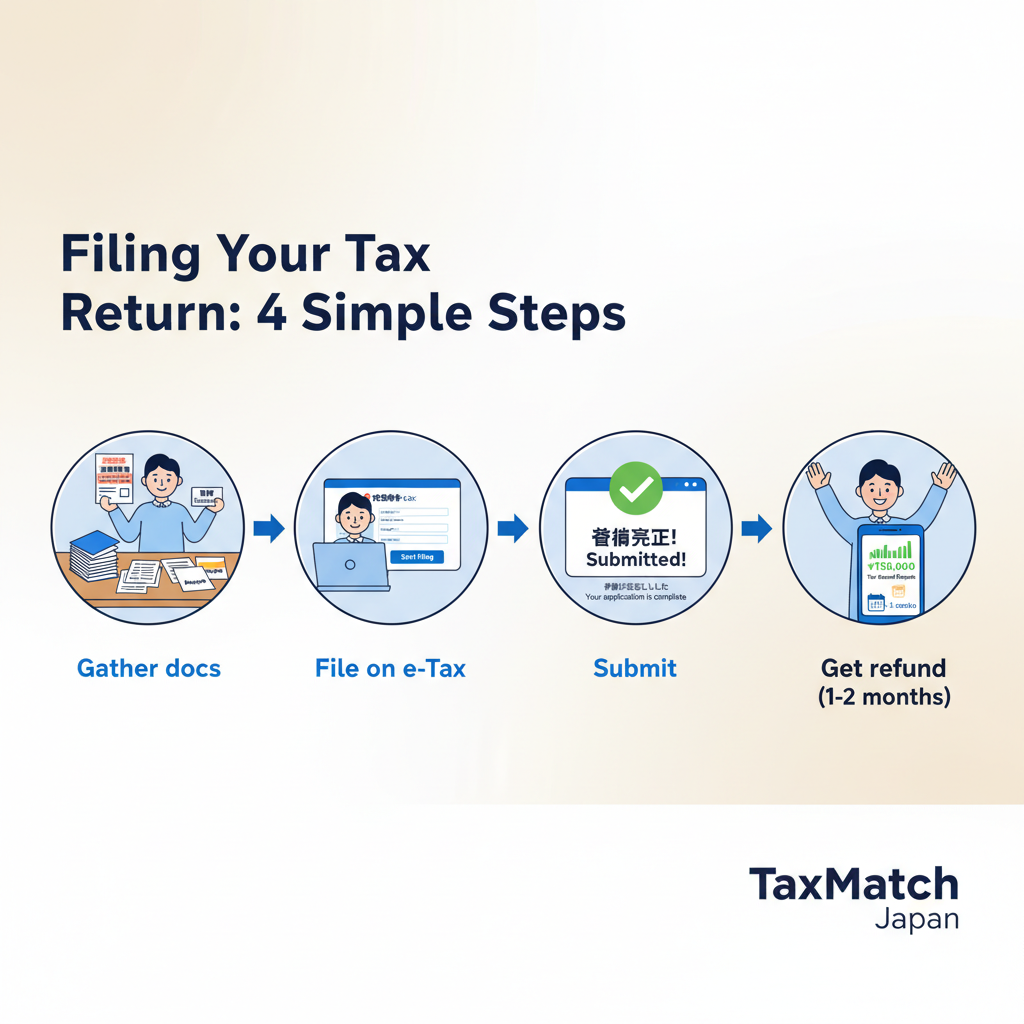
Filing your tax return: 4 simple steps
Who Must File a Tax Return?
Most employees in Japan have their taxes handled by their employer through withholding (源泉徴収) and year-end adjustment (年末調整). However, you must file a tax return yourself if any of the following apply:
| Situation | Filing Required? |
|---|---|
| Annual salary exceeds ¥20 million | Yes — mandatory |
| Salary from 2+ employers, and secondary income exceeds ¥200,000 | Yes — mandatory |
| Side job / freelance income exceeds ¥200,000 (total, after expenses) | Yes — mandatory |
| Receiving salary from an overseas company (not withheld in Japan) | Yes — mandatory |
| Left your employer mid-year without year-end adjustment | Yes — mandatory |
| Crypto gains, rental income, or other non-salary income exceeding ¥200,000 | Yes — mandatory |
| Only one employer, year-end adjustment completed, no side income | No — but you may want to file voluntarily for a refund |
The ¥200,000 Side Job Trap
This is the most common mistake foreign workers make in Japan.
If your side income is under ¥200,000, you are exempt from filing a national income tax return. However, this exemption does not apply to resident tax (住民税), which is collected by your local municipality.
⚠️ Warning: Even ¥50,000 in Side Income Requires Resident Tax Reporting
If you don’t file an income tax return, you must separately report your side income to your city/ward office for resident tax purposes. Failing to do so can result in back taxes with penalties — and more importantly, it can hurt your visa renewal or permanent residency application. Immigration checks your tax compliance history.
The simplest solution: Just file a national income tax return even for small side income. The data is automatically shared with your municipality, covering both national and local taxes in one filing.
When You Should File Voluntarily (Refunds)
Even if you’re not required to file, you may be entitled to a refund by claiming deductions your employer didn’t process:
- Medical expenses: If out-of-pocket medical costs for your household exceeded ¥100,000, you can claim a deduction (or use the Self-Medication system for OTC drugs over ¥12,000)
- Furusato Nozei (hometown tax): If you donated to 6+ municipalities, or forgot to submit the One-Stop Exception form
- Foreign tax credit: If you paid taxes in another country on the same income that is also taxed in Japan
- First year of your mortgage: The housing loan deduction requires a tax return in year one
📌 Refund Returns Can Be Filed Early
Unlike regular tax returns (Feb 16–Mar 16), refund returns can be submitted from January 1. Filing early means you’ll get your money back faster — typically within 3 weeks via e-Tax.
Required Documents Checklist
| Document | What It Is | Where to Get It |
|---|---|---|
| My Number Card | Required for e-Tax authentication | Your local city/ward office |
| Withholding Tax Statement (源泉徴収票) | Shows your annual salary, deductions, and taxes withheld | Your employer (issued in January) |
| Medical receipts (if claiming) | Proof of medical expenses | Hospitals, pharmacies, or download XML from your health insurance portal |
| Furusato Nozei receipts (if claiming) | Donation certificates | Each municipality you donated to |
| Overseas income records | Brokerage statements, bank records, pay stubs from foreign companies | Your overseas accounts |
| Japanese bank account info | For receiving refunds | Your bank passbook or card |
| Residence Card | For identity verification (if not using My Number Card) | Immigration Bureau |
Step-by-Step: Filing via e-Tax
e-Tax is the recommended filing method. It’s faster, you get refunds sooner, and it generates a legally binding electronic receipt. Here’s how to do it:
Step 1: Access the Tax Return Preparation Corner
Go to the National Tax Agency website (nta.go.jp) and open the “確定申告書等作成コーナー” (Tax Return Preparation Corner). Select “Start Creation” → “Year 2025 (Reiwa 7)” → “e-Tax using smartphone (My Number Card method).”
📌 Language Tip
The e-Tax system is in Japanese only, but the NTA publishes a detailed English PDF guide each year. Use it alongside Google Chrome’s built-in translation. The combination works well for most foreign filers.
Step 2: Authenticate with My Number Card
A QR code will appear on your screen. Open the “Mynaportal App” on your NFC-compatible smartphone, scan the QR code, hold your My Number Card against the back of your phone, and enter your 4-digit PIN.
Step 3: Enter Your Income
Transcribe the amounts from your Withholding Tax Statement (源泉徴収票): payment amount, income after deduction, and tax withheld. If you have side income or overseas income, enter those separately as “miscellaneous income” (雑所得).
Step 4: Enter Your Deductions
Deductions from year-end adjustment are carried over automatically. Add any additional deductions:
- Medical expenses (upload XML data or enter manually)
- Furusato Nozei donations
- Foreign tax credit
The 2025 Special Basic Deduction (up to ¥950,000) is calculated automatically by the system based on your total income.
Step 5: Review and Submit
The system calculates your final tax. A negative number means you’ll get a refund. A positive number means you owe additional tax. Review the summary, then submit electronically. You’ll receive a receipt notification in your e-Tax message box.
Step 6: Enter Refund Account or Pay
If you’re getting a refund, enter your Japanese bank account details. Refunds via e-Tax typically arrive in 3 weeks to 1.5 months.
📝 Bonus: Resident Tax Is Handled Automatically
When you file via e-Tax, your income data is automatically shared with your municipality. You do not need to file a separate resident tax return. Your local government will calculate and send you a resident tax notice from June.
How to Pay (or Get Your Refund)
If you owe additional tax, you must pay by March 16, 2026. The tax office will not send you a bill — you need to act proactively.
| Payment Method | Details |
|---|---|
| Automatic bank transfer (振替納税) | Submit the request by Mar 16. Withdrawal happens on April 23, 2026 — gives you extra time. |
| Credit card | Via the national tax credit card payment site. ~¥80 fee per ¥10,000. |
| Smartphone payment (PayPay, etc.) | Free, instant. Limited to ¥300,000 or less. |
| Convenience store (QR code) | Print QR code from e-Tax, pay cash at the register. Up to ¥300,000. |
| At the bank or tax office | Traditional method. Bring your payment slip. |
Filing In Person at a Tax Office
If online filing feels too complicated, you can file in person at your local tax office between February 16 and March 16. However, reservations are now required.
- LINE reservation: Add the NTA’s official LINE account and book a time slot (Japanese only)
- Same-day tickets: Paper numbered tickets are distributed at the venue entrance each morning, but they run out quickly
⚠️ No English Support Guaranteed at Tax Offices
General tax office consultation counters do not guarantee English-speaking staff. Some cities offer special multilingual help desks during filing season (e.g., Sapporo’s International Communication Plaza runs English tax consultations with professional tax accountants). Check with your local international exchange association.
Special Rules for Foreign Residents
Your tax obligations in Japan depend on your residency status for tax purposes — which is different from your visa status.
| Tax Residency Status | Definition | What’s Taxed in Japan |
|---|---|---|
| Non-Resident | No domicile in Japan, lived here < 1 year | Japan-sourced income only (flat 20.42%) |
| Non-Permanent Resident | Non-Japanese, lived in Japan ≤ 5 years (within past 10 years) | Japan-sourced income + overseas income remitted to Japan |
| Permanent Resident (tax) | Lived in Japan > 5 years (within past 10 years) | Worldwide income — everything, everywhere |
⚠️ “Remittance” Includes Credit Cards
If you’re a non-permanent resident, overseas income is only taxed when “remitted” to Japan. But “remittance” doesn’t just mean bank transfers — using an overseas credit card or debit card in Japan counts as remitting funds, which can trigger tax on your offshore income. This is one of the most commonly missed rules.
Leaving Japan? Appoint a Tax Agent
If you’re leaving Japan before the filing deadline, you have two options:
- File a “quasi-tax return” and pay before you leave. You calculate tax on income earned from Jan 1 up to your departure date and pay in full.
- Appoint a Tax Agent (納税管理人) — this is the recommended option. Before leaving, submit a “Notification of Tax Agent” at your tax office. Your agent (a friend, colleague, or tax accountant in Japan) can file your return during the regular period and receive any refund on your behalf.
📌 Don’t Forget Your Pension Refund
If you paid into Japan’s pension system for 6 months to 10 years, you can claim a Lump-Sum Withdrawal Payment after leaving. The government withholds 20.42% — but your tax agent can file a return to get most or all of that back. Appointing a tax agent before departure is essential to claim this refund.
Get Help Filing Your Tax Return
Need a Bilingual Tax Accountant?
Filing taxes in Japan doesn’t have to be stressful. TaxMatch Japan connects you with English-speaking certified tax accountants (税理士) who can handle your entire filing — completely free matching.
We typically respond within 24 hours.
Frequently Asked Questions
How do I file a tax return in Japan as a foreigner?
Visit your local tax office (zeimusho) or use the NTA’s online e-Tax system between February 16 and March 15. You’ll need your My Number Card, income documents (gensen choshuhyo), and deduction receipts. English-speaking tax accountants can file on your behalf.
Can I file my Japanese tax return online?
Yes. The NTA’s e-Tax system allows online filing with a My Number Card and card reader (or smartphone). However, the interface is primarily in Japanese. Many foreigners use a bilingual tax accountant for accuracy.
What documents do I need to file taxes in Japan?
Essential documents include: withholding tax slip (gensen choshuhyo) from your employer, My Number Card, bank account details for refunds, and receipts for deductions (medical expenses, social insurance, life insurance, furusato nozei).
Do all foreigners need to file a tax return in Japan?
Not always. If you have only one employer and your company does year-end adjustment (nenmatsu chosei), you may not need to file. However, you must file if you have multiple income sources, earn over ¥20 million, or want to claim deductions not covered by year-end adjustment.
Disclaimer
This article is for informational purposes only and does not constitute tax, legal, or financial advice. Tax laws are subject to change. The 2025 Special Basic Deduction and other reform details reflect our understanding as of early 2026. Always consult a qualified tax professional (税理士) for your specific situation. TaxMatch Japan is a matching service and does not provide tax advice directly.