
Japan Health Insurance for Foreigners: NHI Enrollment, Costs & What Expats Need to Know (2026)
Do foreigners need health insurance in Japan? Yes — all residents must enroll in either employer-provided health insurance (shakai hoken) or National Health Insurance (NHI / kokumin kenko hoken). Premiums are based on your previous year’s income, typically 5–10% of annual income. Here is the complete guide for expats.
Quick Summary: NHI for Foreign Residents
- Mandatory: All residents with a visa >3 months must enroll (unless covered by employer insurance)
- Enroll within 14 days of arriving or losing employer coverage — at your local city/ward office
- You pay 30% of medical costs; NHI covers 70%
- Premiums: Based on previous year’s income — roughly ¥400,000/year at ¥4M income, ¥940,000 at ¥8M
- Visa risk: Unpaid NHI premiums will be checked during visa renewals starting 2027
Read on for enrollment steps, premium calculations, coverage details, and compliance requirements.
Table of Contents
- Who Must Enroll in NHI?
- How to Enroll (Step by Step)
- How Much Does NHI Cost?
- Premium Reductions & Your First Year
- What NHI Covers (and Doesn’t)
- High-Cost Medical Care: The Monthly Cap
- NHI vs. Employer Insurance
- NHI and Visa Compliance
- FAQ
Need a tax accountant to help with NHI and tax optimization? We’ll match you — free.
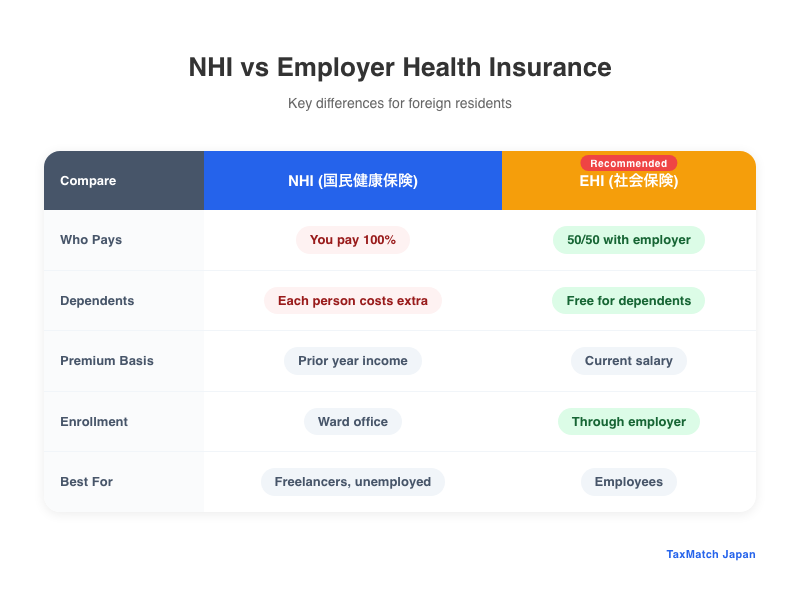
NHI vs Employer Insurance: Key differences
Who Must Enroll in NHI?
Japan has universal health coverage — everyone living here must be insured. If you’re not covered by your employer’s health insurance (Shakai Hoken), you must join the National Health Insurance (NHI) run by your local municipality.
You must enroll in NHI if you are:
- A freelancer or sole proprietor
- An international student
- Unemployed or between jobs
- A part-time worker not qualifying for employer insurance
- A dependent of an NHI enrollee (each person enrolls individually — unlike employer insurance)
Exempt from NHI:
- Short-term visitors (visa ≤90 days)
- Medical visa holders
- Workers from countries with Social Security Agreements that cover health insurance (US, France, Belgium, Netherlands, etc.) — you’ll need a Certificate of Coverage from your home country
Our matched tax accountants help foreign residents navigate insurance and tax obligations.
Get Help with NHI and Tax Questions →
Free matching · No obligation · English support
How to Enroll (Step by Step)
Visit your local city or ward office within 14 days of becoming eligible. Bring:
| Document | Purpose |
|---|---|
| Passport | Identity verification |
| Residence Card (在留カード) | Proof of legal residency (visa >3 months) |
| My Number Card (or notification) | Tax linkage |
| Certificate of Loss of Eligibility | Only if switching from employer insurance — proves when coverage ended |
| Bank book + personal seal | To set up direct debit for premiums |
⚠️ Late Enrollment = Back-Payment
If you register late, premiums are charged retroactively to the date you became eligible — up to 2 years back. And if you need medical care before enrolling, you’ll pay 100% out-of-pocket until registration is complete.
📌 My Number Card = Your Health Insurance Card (from Dec 2025)
Physical NHI cards are being phased out. From December 2025, your My Number Card works as your health insurance card at clinics and hospitals. If you don’t have one yet, the city office will issue an “Eligibility Confirmation Form” as a temporary substitute.
How Much Does NHI Cost?
NHI premiums are calculated by your municipality based on your previous year’s income. Unlike employer insurance, there’s no employer subsidy — you pay 100%.
The premium has three components:
| Component | What It Funds | Who Pays |
|---|---|---|
| Medical portion | General healthcare (70% coverage) | All NHI members |
| Elderly support portion | Late-stage elderly medical care system | All NHI members |
| Nursing care portion | Long-term care insurance | Ages 40-64 only |
Each component includes an income-based rate (~15% combined) plus a flat per-person fee.
Example calculations (Central Tokyo, FY2025):
| Profile | Annual Income | Estimated Annual NHI Premium | Monthly |
|---|---|---|---|
| Single, age 30 | ¥4,000,000 | ~¥398,000 | ~¥33,000 |
| Single, age 45 | ¥8,000,000 | ~¥941,000 | ~¥78,000 |
| Family (spouse + 1 child), age 30 | ¥4,000,000 | ~¥570,000-600,000 | ~¥48,000-50,000 |
📌 Blue Return = Lower NHI Premiums
If you’re a freelancer filing a Blue Return with the ¥650,000 deduction, your NHI base income is reduced by ¥650,000. At a ~15% income rate, that saves roughly ¥100,000/year on health insurance alone. (See our Freelancer Tax Guide.)
Premium Reductions & Your First Year
Automatic income-based reductions: If your household income is low, flat-rate portions of your premium are automatically reduced:
| Reduction | Applies When Household Income Is Below |
|---|---|
| 70% off flat portions | ~¥430,000 (single person) |
| 50% off flat portions | ~¥720,000-735,000 (single person) |
| 20% off flat portions | ~¥965,000-990,000 (single person) |
Your first year in Japan: Since premiums are based on previous year’s Japanese income, new arrivals with zero prior-year income qualify for the 70% reduction. This creates artificially low premiums in year one — followed by a significant jump in year two when your actual earnings are factored in.
⚠️ You Must File an Income Declaration — Even With Zero Income
If you don’t file a tax return or income declaration, the city cannot verify your income and cannot apply any reductions. You’ll be billed the maximum baseline rate. Always file — even if your income was zero.
Job loss relief: If you were laid off (involuntary), your previous salary income is counted at only 30% for NHI premium calculation. Register at Hello Work first, then bring proof to your city office.
What NHI Covers (and Doesn’t)
You pay 30% of medical costs. NHI covers the remaining 70%.
(Copayment is 20% for children under 6, and 10-20% for seniors 70+)
Covered:
- Doctor visits, specialist consultations
- Surgery and hospitalization
- Basic dental (fillings, extractions, root canals)
- Prescription medications
- Mental health treatment
- MRI, blood tests, and diagnostics
NOT covered (100% out-of-pocket):
- Cosmetic surgery and advanced orthodontics
- Private hospital room upgrades
- Comprehensive health checkups (人間ドック)
- Travel vaccines
- Normal childbirth (but a ¥500,000 lump-sum birth allowance is provided separately)
High-Cost Medical Care: The Monthly Cap
Japan protects you from catastrophic medical bills. If your 30% copayment exceeds a monthly limit, the excess is fully reimbursed.
| Income Level | Monthly Out-of-Pocket Cap (Under Age 70) |
|---|---|
| High income (>¥9M) | ~¥252,600 + 1% of costs above ¥842,000 |
| Upper-middle (¥6M-9M) | ~¥167,400 + 1% above ¥558,000 |
| Standard (¥2.1M-6M) | ~¥80,100 + 1% above ¥267,000 |
| Lower income (<¥2.1M) | ¥57,600 |
| Tax-exempt | ¥35,400 |
If you hit the cap 4+ times in 12 months, the cap drops further (e.g., ¥80,100 → ¥44,400). For planned surgeries, you can apply in advance so the hospital only charges up to your cap at checkout — no need to front the full amount.
NHI vs. Employer Insurance (Shakai Hoken)
| Feature | NHI | Employer Insurance (EHI) |
|---|---|---|
| Premium split | 100% you | 50% you / 50% employer |
| Premium basis | Previous year’s income | Current monthly salary |
| Dependents | Each pays separately | Covered free |
| Administration | You handle it at city office | Employer handles it |
Key takeaway: If you have a non-working spouse and children, employer insurance (EHI) is dramatically cheaper because dependents are free. Switching from employment to freelance means each family member generates a separate NHI premium.
If you lose your job: You can either switch to NHI or continue your employer insurance for up to 2 years (“voluntary continuation”) at 100% of the premium (no employer share). Compare costs — voluntary continuation is sometimes cheaper if your previous salary was moderate.
NHI and Visa Compliance
⚠️ Starting 2027: Immigration Will Check Your NHI Payment History
The government is integrating NHI, resident tax, and pension data into the immigration screening system. Unpaid NHI premiums will be grounds for visa denial, reduced visa periods, and even revocation of Permanent Residency.
Even paying off arrears right before your visa renewal won’t fully fix the problem — the historical record of delinquency remains visible.
What this means for you:
- Enroll in NHI on time (within 14 days)
- Pay premiums on time — set up direct debit
- File your tax return every year (even with zero income)
- Keep payment records for visa renewal applications
Questions About NHI or Taxes?
Need a Bilingual Tax Accountant?
NHI premiums, tax deductions, and social insurance are deeply interconnected. A bilingual tax professional can help you optimize your filings to legally minimize both your taxes and NHI costs. Matching is completely free.
We typically respond within 24 hours.
Frequently Asked Questions
Do foreigners need health insurance in Japan?
Yes. All residents of Japan, including foreigners on any visa longer than 3 months, are legally required to have health insurance. This is either employer-provided (shakai hoken) or National Health Insurance (NHI).
How much does health insurance cost for expats in Japan?
NHI premiums are calculated based on your previous year’s income and vary by municipality. As a rough guide, expect to pay 5–10% of your annual income. A person earning ¥5 million/year might pay roughly ¥350,000–¥500,000/year in NHI premiums.
Can I use private insurance instead of NHI in Japan?
No. Private insurance does not exempt you from the legal requirement to enroll in NHI or shakai hoken. You can have private insurance in addition to the public system, but not instead of it.
What happens if I don’t enroll in health insurance in Japan?
You will be retroactively enrolled and billed for all missed months when discovered. Unpaid premiums can affect visa renewals and permanent residency applications. The immigration bureau checks tax and insurance compliance.
Disclaimer
This article is for informational purposes only and does not constitute medical, tax, or legal advice. NHI premium rates vary by municipality and are revised annually. The examples shown use approximate FY2025 Central Tokyo rates. The 2027 immigration data integration timeline reflects announced government policy as of early 2026. Always confirm current rates with your local city/ward office and consult a qualified tax professional for your specific situation.