
Japan Pension Lump-Sum Withdrawal & Tax Refund Guide (2026)
Leaving Japan? You could be owed hundreds of thousands of yen in pension refunds — but only if you act within 2 years. Here’s exactly how to claim your lump-sum withdrawal and get back the 20.42% tax that’s automatically deducted.
Important Notice
This article is for general informational purposes only and does not constitute tax, legal, or financial advice. Pension and tax rules vary by individual circumstances and nationality. Always consult a qualified tax professional for advice on your specific situation.
Need help with your pension refund or tax filing? Get matched with a bilingual tax accountant — free.
Get Matched Free →If you’ve worked in Japan for at least 6 months, you’ve been paying into the national pension system — whether you realized it or not. When you leave Japan permanently, you’re entitled to claim a lump-sum withdrawal payment (脱退一時金 / dattai ichijikin) that returns a portion of those premiums.
But here’s what most people don’t know: the Japanese government automatically withholds 20.42% in income tax from your payment. With the right paperwork, you can get every yen of that tax back. This guide walks you through the entire two-step process.
Table of Contents
- What Is the Lump-Sum Withdrawal Payment?
- How Much Will You Receive?
- The 20.42% Tax: Why It’s Deducted and How to Get It Back
- The Tax Agent (納税管理人): Your Essential Link in Japan
- Step-by-Step Process: From Departure to Refund
- Critical Decision: Should You Claim or Keep Your Pension Record?
- DIY vs Professional Service: Cost Comparison
- Tax in Your Home Country
- Common Mistakes to Avoid
- Checklist: Before You Leave Japan
- Key Takeaways
- Frequently Asked Questions
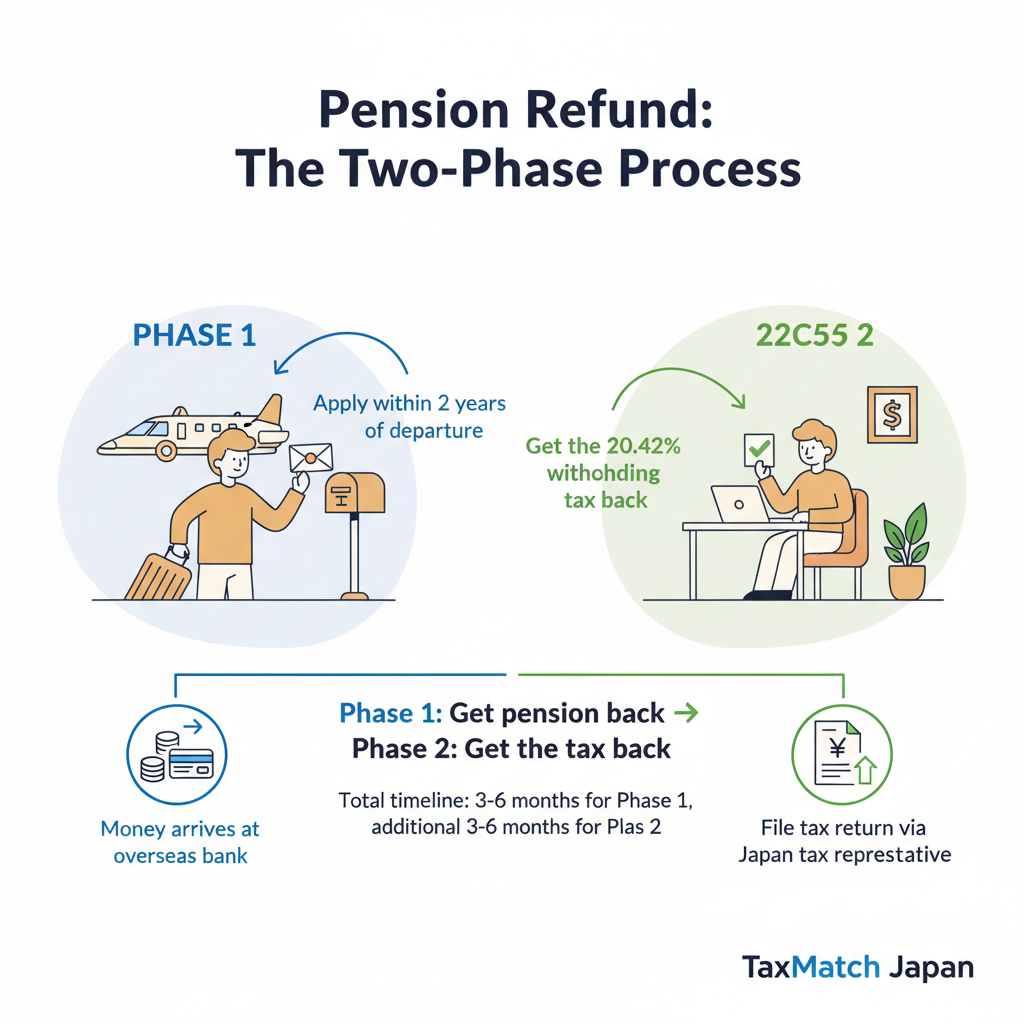
Pension Refund: The two-phase process
1. What Is the Lump-Sum Withdrawal Payment?
Japan requires all residents aged 20-59 to enroll in the public pension system, regardless of nationality. For foreigners who leave Japan before accumulating 10 years of contributions (the minimum for a future pension), this means your premiums would simply be lost.
The lump-sum withdrawal payment solves this problem. It allows short-to-medium-term foreign workers to reclaim a portion of their pension contributions after leaving Japan.
Eligibility Requirements
You must meet all of the following conditions:
- You are not a Japanese national
- You no longer have a registered address in Japan (you’ve submitted your moving-out notification / 転出届)
- You have at least 6 months of pension premium payments
- You have never received any Japanese pension benefits (including disability pension)
- You have less than 10 years of total pension contributions (if you have 10+ years, you qualify for a future pension instead)
Critical Deadline: 2 Years from Departure
You must submit your claim to the Japan Pension Service within 2 years of leaving Japan. Miss this deadline by even one day and your right to claim is permanently lost. There are no exceptions.
Ensure you claim the maximum lump-sum withdrawal and handle tax obligations correctly.
Get Help with Your Pension Refund →Free matching · No obligation · English support
2021 Reform: 5-Year Cap (Previously 3 Years)
Before April 2021, the calculation was capped at 36 months (3 years) of contributions — meaning anyone who worked longer than 3 years effectively lost the excess premiums. The 2021 reform extended this cap to 60 months (5 years), significantly increasing payouts for longer-term workers.
If your final premium payment was made in April 2021 or later, the new 5-year cap applies to you.
2. How Much Will You Receive?
For Employees’ Pension Insurance (厚生年金 / kousei nenkin — the type most salaried workers are enrolled in), the formula is:
Payout = Average Standard Remuneration × Multiplier
Your Average Standard Remuneration is calculated from your monthly salary grades and bonuses over your enrollment period. The multiplier depends on how many months you contributed:
| Months Enrolled | Multiplier |
|---|---|
| 6 – 11 months | 0.5 |
| 12 – 17 months | 1.1 |
| 18 – 23 months | 1.6 |
| 24 – 29 months | 2.2 |
| 30 – 35 months | 2.7 |
| 36 – 41 months | 3.3 |
| 42 – 47 months | 3.8 |
| 48 – 53 months | 4.4 |
| 54 – 59 months | 4.9 |
| 60 months (5 years)+ | 5.5 |
Real-World Calculation Examples
| Scenario | Avg. Remuneration | Months | Gross Payout | Tax Withheld (20.42%) | You Receive | Refundable Tax |
|---|---|---|---|---|---|---|
| English teacher, 2 years | ¥300,000 | 24 | ¥660,000 | ¥134,772 | ¥525,228 | ¥134,772 |
| Engineer, 3.5 years | ¥450,000 | 42 | ¥1,710,000 | ¥349,182 | ¥1,360,818 | ¥349,182 |
| Manager, 7 years | ¥600,000 | 84* | ¥3,300,000 | ¥673,860 | ¥2,626,140 | ¥673,860 |
*Even with 84 months of contributions, the calculation is capped at 60 months (multiplier 5.5). The excess 24 months of premiums are not refunded.
National Pension (国民年金) Note: If you were enrolled in the National Pension (typically self-employed or non-working residents), the lump-sum withdrawal is calculated differently and — importantly — no tax is withheld. You receive the full amount with no refund process needed.
3. The 20.42% Tax: Why It’s Deducted and How to Get It Back
When the Japan Pension Service sends your lump-sum withdrawal to your overseas bank account, they automatically deduct 20.42% as income tax. This is because:
- The payment is classified as retirement income under Japanese tax law
- You are a non-resident at the time of payment
- Japan applies a flat 20.42% withholding rate on retirement income paid to non-residents (20% income tax + 0.42% reconstruction surcharge)
The good news: Under Article 171 of Japan’s Income Tax Act, you can file a tax return as if you were a resident, applying Japan’s generous retirement income deduction (退職所得控除). Since the deduction almost always exceeds the lump-sum amount, your taxable income becomes zero — and the entire 20.42% is refunded.
Why the Full Amount Is Almost Always Refundable
Japan’s retirement income deduction is calculated as ¥400,000 × years of service (for up to 20 years). For a 5-year enrollment period, that’s a ¥2,000,000 deduction. Since most lump-sum withdrawals fall well below this threshold, the taxable amount is ¥0 and the full withholding is returned to you.
4. The Tax Agent (納税管理人): Your Essential Link in Japan
Here’s the catch: to get your tax refund, someone in Japan needs to file a tax return on your behalf. You can’t do this from abroad because:
- The tax office cannot send refunds to overseas bank accounts — the money must go to a Japanese bank account
- The tax return requires physical submission of original documents
- You’ve likely already closed your Japanese bank account
This is why you need a Tax Agent (納税管理人 / nozei kanrinin) — a person or entity in Japan who handles your tax affairs after you leave.
Who Can Be Your Tax Agent?
No special license is required. Your tax agent can be:
- A friend or former colleague still living in Japan (most common for DIY approach)
- Your former employer’s HR department (though many companies decline)
- A tax accountant (zeirishi) or specialized pension refund service (most reliable)
When to Register Your Tax Agent
Before you leave Japan (recommended): Visit your local tax office and submit the “Notification of Tax Agent” form. This lets your agent start acting immediately once you’re gone.
After you leave (still possible): Your tax agent can submit the notification together with the tax refund filing. This works but adds complexity.
5. Step-by-Step Process: From Departure to Refund
The entire process takes approximately 6 to 10 months from departure to receiving your full refund. Here’s each phase:
Phase 1: Before Leaving Japan
| Step | Action | Where |
|---|---|---|
| 1 | Submit your moving-out notification (転出届) at your city/ward office. This deregisters your address and is required for eligibility. | City/Ward Office |
| 2 | Appoint a tax agent and submit the notification form to your local tax office. | Tax Office |
| 3 | Keep your pension handbook (年金手帳) or basic pension number (基礎年金番号). You’ll need this to file your claim. | Take it with you |
Phase 2: After Returning Home — Claim the Lump Sum
| Step | Action | Timeline |
|---|---|---|
| 4 | Mail your claim form (脱退一時金裁定請求書) to the Japan Pension Service with passport copy, bank details, and pension number. | As soon as possible after departure |
| 5 | Receive ~79.58% of your payout in your overseas bank account (after 20.42% tax withholding). | 3–4 months after claim |
Phase 3: Get the 20.42% Tax Back
| Step | Action | Timeline |
|---|---|---|
| 6 | Receive the “Notice of Entitlement” (脱退一時金支給決定通知書) by mail at your overseas address. This is a postcard-sized original document. Do NOT throw it away. | Around the same time as Step 5 |
| 7 | Send the original notice to your tax agent in Japan via trackable international mail (EMS, DHL, etc.). | Immediately after receiving it |
| 8 | Your tax agent files a tax return (退職所得の選択課税 / elective taxation on retirement income) at the tax office, attaching the original notice. | Can be filed anytime — no need to wait for Feb-Mar filing season |
| 9 | Tax refund deposited into your tax agent’s Japanese bank account. | 1–2 months after filing |
| 10 | Tax agent transfers the refund to your overseas account via international wire (Wise, bank transfer, etc.). | A few days after Step 9 |
Filing Deadline for the Tax Refund: You have 5 years from the date you received the lump-sum payment to file the tax return. This is separate from the 2-year deadline for claiming the pension itself.
6. Critical Decision: Should You Claim or Keep Your Pension Record?
Before rushing to claim your lump-sum withdrawal, you need to consider one crucial factor: Social Security Agreements (SSAs).
Japan has bilateral pension agreements with 24 countries. These agreements serve two functions:
- Prevent double enrollment: So you don’t pay into two countries’ systems simultaneously
- Totalize (combine) pension periods: So years worked in Japan count toward your home country’s pension eligibility
If you claim the lump-sum withdrawal, your Japanese pension record is permanently erased. It can never be used for totalization with your home country.
Countries with Totalization (Period Combining)
If you’re from one of these countries, think carefully before claiming:
USA, Germany, France, Canada, Australia, Philippines, Brazil, Switzerland, Belgium, Ireland, Hungary, Czech Republic, Slovakia, Finland, Sweden, Luxembourg
Countries WITHOUT Totalization (Double-Coverage Prevention Only)
If you’re from one of these countries, claiming the lump sum is generally the best option:
UK, South Korea, China, Italy, India
The US Example: Why This Matters
Consider an American who worked 7 years in the US and 3 years in Japan:
| Option | Immediate Cash | Long-Term Impact |
|---|---|---|
| Claim lump sum | ¥660,000 – ¥1,000,000+ | Japanese record erased. Only 7 years of US Social Security credits. Needs 3 more years in the US to qualify for any pension. |
| Keep pension record | ¥0 | Japan’s 3 years totalized with US’s 7 years = 10 years total. Qualifies for US Social Security (requires 40 credits / ~10 years). Also eligible for a small Japanese pension. |
For Americans and other totalization-eligible nationals with borderline qualification periods, keeping the pension record can be worth tens of thousands of dollars in lifetime pension benefits — far exceeding the one-time lump sum.
Rule of Thumb: If you’re from a totalization country AND your combined years in Japan + home country are close to meeting your home country’s pension eligibility threshold, seriously consider not claiming the lump sum. Consult a pension specialist before deciding.
7. DIY vs Professional Service: Cost Comparison
You have two options for handling the tax refund process: do it yourself through a friend in Japan, or hire a professional service.
Professional Service Fee Structures
| Fee Type | Typical Range | Best For |
|---|---|---|
| Percentage-based | 12.5% – 25% of refund amount | Small refunds (<¥500,000 gross payout) |
| Fixed fee | ¥30,000 – ¥60,000 | Larger refunds — saves significantly vs percentage model |
Cost Impact Example
For an engineer with a ¥1,710,000 payout and ¥349,182 tax refund:
| Approach | Cost | You Keep |
|---|---|---|
| DIY (friend as tax agent) | ¥0 | ¥349,182 |
| Fixed-fee service (¥40,000) | ¥40,000 | ¥309,182 |
| Percentage service (20%) | ¥69,836 | ¥279,346 |
DIY vs Professional: Pros and Cons
| Factor | DIY (Friend as Agent) | Professional Service |
|---|---|---|
| Cost | Free | ¥30,000 – ¥70,000+ |
| Reliability | Risk of friend moving/losing contact | Guaranteed completion |
| Language | Friend needs Japanese ability | Handled in English |
| Burden on friend | Multiple tax office visits, paperwork | None |
| Success rate | ~23% complete the process | ~100% |
If you have a reliable, long-term friend in Japan who speaks Japanese, DIY can work. For everyone else, a professional service is strongly recommended — the cost is small relative to the refund amount.
8. Tax in Your Home Country
Getting your Japanese tax refund doesn’t mean you’re completely tax-free. Depending on your nationality, you may need to report the lump-sum withdrawal in your home country:
- US citizens/residents: The IRS treats this as a foreign pension distribution. It’s reportable as gross income on your US return. The Japan-US tax treaty may apply, and any Japanese tax paid can potentially be credited via FTC.
- UK residents: HMRC may tax overseas pension lump sums under post-2017 rules, though deductions may apply.
- Other countries: Check your country’s treatment of foreign pension distributions. Most countries with Japan tax treaties provide some form of relief.
This is another reason to ensure you claim your Japanese tax refund — you may need those funds to cover home-country tax obligations.
9. Common Mistakes to Avoid
Missing the 2-Year Pension Claim Deadline
The #1 mistake. Life gets busy after moving home, and before you know it, 2 years have passed. File as soon as possible after departure. The tax refund has a separate 5-year window, but the pension claim itself must be within 2 years.
Throwing Away the Notice of Entitlement
The postcard-sized notification from the Japan Pension Service is your key to the tax refund. It looks like junk mail. The tax office requires the original — copies are not accepted. If you lose it, you’ll need to request a reissue, which delays the process by weeks.
Not Appointing a Tax Agent Before Leaving
If you leave Japan without a tax agent and later lose contact with friends there, you’ll need to find and hire a professional service from overseas — more expensive and more complicated than setting it up before departure.
Claiming the Lump Sum When You Shouldn’t
If you’re from a totalization country (US, Germany, etc.) and close to meeting your home country’s pension eligibility, the lifetime pension benefits could vastly exceed the one-time payment. This is the most financially damaging mistake — and it’s irreversible.
Not Knowing About the 20.42% Tax Refund
Many people accept the reduced payment without realizing they can reclaim the tax. Don’t leave ¥100,000+ on the table.
Using Japan Post Bank (Yucho) for Receiving the Pension
Japan Post Bank has limitations with international transfers. Always designate a major commercial bank in your home country for receiving the lump-sum payment.
Checklist: Before You Leave Japan
- 1 month before departure: Submit moving-out notification (転出届) at your city/ward office
- 1 month before departure: Appoint a tax agent and file the notification at your tax office
- Before leaving: Confirm your basic pension number (基礎年金番号) and take your pension handbook with you
- Before leaving: If from a totalization country (US, Germany, Canada, etc.), consult a specialist about whether to claim vs. keep your record
- After arriving home: Mail your claim form to the Japan Pension Service immediately
- When notice arrives: Do NOT throw away the Notice of Entitlement — send the original to your tax agent via trackable mail
Key Takeaways
- Claim within 2 years of leaving Japan. This deadline is absolute.
- You can get back the full 20.42% tax through a simple tax return filed by your tax agent in Japan.
- Appoint a tax agent before you leave. It’s the single most important preparation step.
- Check your Social Security Agreement status. Americans, Germans, Canadians, and others may be better off keeping their pension record for totalization.
- Keep the original Notice of Entitlement. No original = no tax refund.
- For refunds over ¥100,000, a fixed-fee service is usually the best value. Don’t overpay with percentage-based pricing.
Leaving Japan and need help with pension refund or tax filing? TaxMatch Japan is free for clients.
Get Matched Free →Disclaimer: This article is for informational purposes only and does not constitute tax, legal, or pension advice. Pension rules and tax treatment vary by individual circumstances, nationality, and applicable bilateral agreements. Always consult qualified professionals before making decisions about your pension. Information is current as of 2026 and subject to change.
Frequently Asked Questions
Can foreigners get a pension refund when leaving Japan?
Yes. Foreign nationals who have contributed to Japan’s pension system (National Pension or Employees’ Pension) and leave Japan can apply for a lump-sum withdrawal payment within 2 years of departure, provided they contributed for at least 6 months.
How much is the lump-sum withdrawal payment?
The amount depends on your salary and contribution period. For Employees’ Pension, it is calculated based on your average monthly salary multiplied by a rate that varies by months of contribution (capped at 60 months for calculation purposes). A 20.42% withholding tax is deducted but can be partially refunded.
How do I apply for a pension refund in Japan?
Submit the Lump-Sum Withdrawal Payment claim form to the Japan Pension Service after leaving Japan. You will need your pension handbook, passport copy, bank account details (Japanese or overseas), and a completed tax representative form (nozei kanrinin) to claim back the 20.42% withholding tax.