
Japan Tax Calendar 2026: Every Deadline Foreigners Need to Know
Living in Japan means navigating a tax system that runs on its own schedule. Miss a deadline and you face penalties, interest charges, or lost deductions. This month-by-month calendar gives you every key date, what to do, and when to do it.
Important Notice
This article is for general informational purposes only and does not constitute tax, legal, or financial advice. Tax rules and rates may change. Always consult a qualified tax professional (zeirishi) for advice specific to your situation.
Need a bilingual tax accountant? Get matched with a specialist — free.
Table of Contents
- At a Glance: 2026 Japan Tax Calendar Summary
- January: The Year Starts With a Residency Check
- February–March: Income Tax Filing Season
- April: New Fiscal Year, Fixed Asset Tax
- May: Cars and Corporations
- June: Residence Tax Season Begins
- July: Pensions and Social Insurance
- August: Second Installments
- September: The Planning Window
- October: Year-End Adjustment Prep Begins
- November: Deadlines Converge
- December: Year-End Wrap-Up
- Year-Round Reminders
- Frequently Asked Questions
1. At a Glance: 2026 Japan Tax Calendar Summary
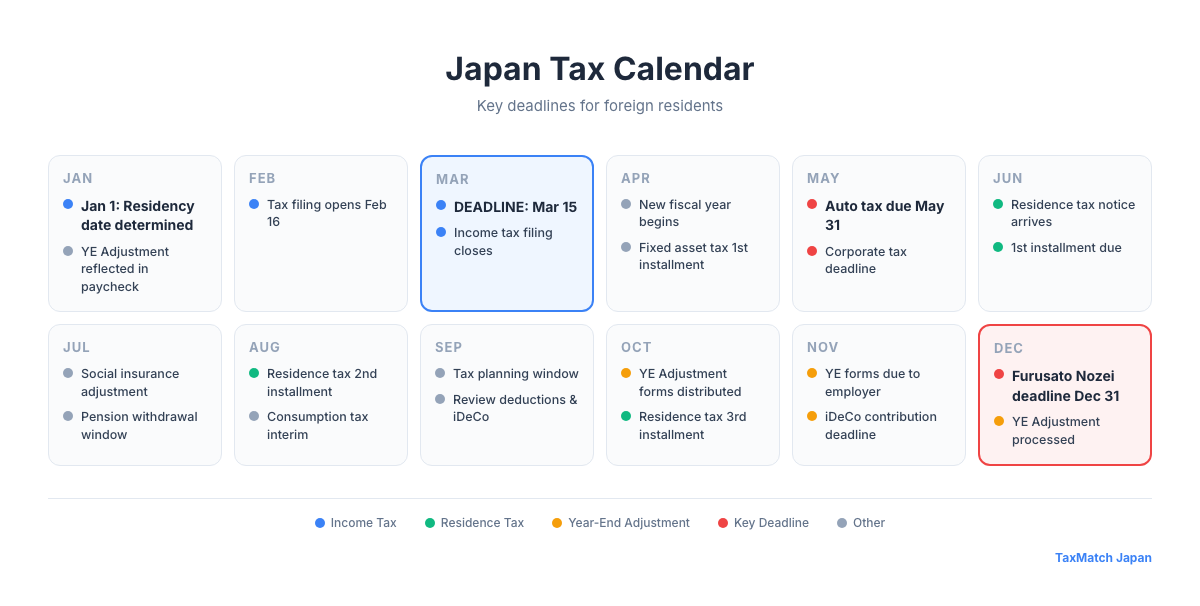
Japan Tax Calendar — All key deadlines at a glance
| Month | Key Event | Who It Affects |
|---|---|---|
| January | Residence tax residency determined (Jan 1); year-end adjustment reflected in paycheck | All residents |
| February | Income tax filing opens (Feb 16) | Filers, freelancers, high earners |
| March | Income tax filing deadline (Mar 15) | Filers, freelancers, high earners |
| April | New fiscal year; fixed asset tax 1st installment | Property owners, business owners |
| May | Auto tax due; corporate tax filing deadline (Mar FY-end) | Vehicle owners, corporations |
| June | Residence tax notifications; 1st installment due | All residents |
| July | Pension lump-sum withdrawal window; social insurance adjustment | Departing residents, employers |
| August | Residence tax 2nd installment; consumption tax interim payment | All residents, business owners |
| September | Mid-year tax planning window | Everyone |
| October | Year-end adjustment forms distributed; residence tax 3rd installment | Employees |
| November | Furusato Nozei deadline approaching; year-end forms due to employer; iDeCo deadline | Employees, taxpayers |
| December | Furusato Nozei final deadline (Dec 31); year-end adjustment processed; bonus taxed | Everyone |
2. January: The Year Starts With a Residency Check
Residence Tax: January 1st Is the Deciding Date
January 1 is the single most important date for residence tax (住民税 / juminzei). Wherever you are registered as a resident on this date determines which municipality you pay residence tax to — and whether you pay it at all.
Action items:
- If you plan to leave Japan permanently, departing before January 1 means you will not owe residence tax for that year.
- If you moved to a new city in December, your new address on January 1 is what counts.
Tip
This is critical for foreigners planning to leave Japan. If you deregister your residence before January 1, you avoid the full year of residence tax — roughly 10% of your previous year’s income. See our leaving Japan tax checklist for the full process.
Year-End Adjustment Results Hit Your Paycheck
If your employer processed your year-end adjustment (年末調整 / nenmatsu chosei) in December, the results are reflected in your January paycheck. Check your pay stub for any refund or additional deduction.
3. February–March: Income Tax Filing Season
The Filing Window: February 16 – March 15
This is the big one. Japan’s income tax filing period (確定申告 / kakutei shinkoku) runs from February 16 to March 15 every year.
You must file a final tax return if you:
- Earned income from two or more employers
- Had freelance, rental, or investment income exceeding 200,000 yen
- Earned more than 20 million yen in annual salary
- Want to claim deductions your employer did not handle (medical expenses, foreign tax credits, etc.)
- Sold real estate or stocks at a profit
- Are a U.S. citizen or green card holder with worldwide income obligations
Action items:
- Gather all withholding tax certificates (源泉徴収票 / gensen choshu-hyo) from every employer.
- Collect receipts for medical expenses, insurance premiums, and charitable donations.
- File online via e-Tax or visit your local tax office.
- Deadline: March 15. Late filing triggers a penalty of 5–15% plus interest.
Tip
Tax offices offer English-language support in limited locations (mainly Tokyo and Osaka). If your tax situation is anything beyond a simple salary, an English-speaking tax accountant is strongly recommended. See our guide to filing your tax return in Japan.
4. April: New Fiscal Year, Fixed Asset Tax
The Government’s Year Resets
April 1 marks the start of Japan’s fiscal year. Government budgets reset, new tax rates may take effect, and corporate accounting cycles begin.
Fixed Asset Tax: 1st Installment
If you own property in Japan, your fixed asset tax (固定資産税 / kotei shisan-zei) 1st installment is due in April (exact date varies by municipality, typically late April).
Action items:
- Property owners: watch for the tax notice from your city hall.
- Budget for approximately 1.4% of assessed property value annually, split across four payments.
5. May: Cars and Corporations
Automobile Tax Due
If you own a vehicle registered in Japan, the automobile tax (自動車税 / jidosha-zei) payment notice arrives in May. Payment deadline is May 31.
Corporate Tax Filing Deadline
Companies with a March fiscal year-end must file their corporate tax return by May 31 (two months after fiscal year-end).
Action items:
- Vehicle owners: pay at a convenience store, bank, or online. Late payment incurs penalties.
- Business owners: ensure your tax accountant has all financial records ready well before the deadline.
6. June: Residence Tax Season Begins
Residence Tax Notifications Arrive
In early June, your municipality sends your residence tax determination notice (住民税決定通知書). This tells you exactly how much you owe for the current fiscal year, based on your previous year’s income.
Payment Options
You pay residence tax one of two ways:
- Payroll deduction (特別徴収 / tokubetsu choshu): Your employer withholds it from your paycheck monthly. The new rate starts from your June paycheck and runs through May of the following year.
- Direct payment (普通徴収 / futsu choshu): You pay in four installments. The 1st installment is due in late June. You can also pay the full year as a lump sum.
Action items:
- Employees: check your June pay stub for the new residence tax deduction amount.
- Self-employed and freelancers: pay the 1st installment by the due date on your notice.
- Review the notice for errors — incorrect dependent counts or missing deductions do happen.
Tip
Residence tax is based on your income from the previous calendar year. If you earned significantly more or less last year, expect a surprise. New arrivals to Japan who had no Japanese income the prior year will owe zero residence tax in their first June — but get ready for the following year. For details, see our residence tax guide.
Confused about your tax obligations? A bilingual tax specialist can help you stay on top of every deadline. Get matched free →
7. July: Pensions and Social Insurance
Pension Lump-Sum Withdrawal
If you have left Japan and were enrolled in the national pension system (国民年金 / kokumin nenkin) or employee pension (厚生年金 / kosei nenkin), you can apply for a lump-sum withdrawal payment (脱退一時金 / dattai ichijikin) after departing. Applications can be submitted within two years of leaving Japan.
Action items:
- Apply from outside Japan using the form from the Japan Pension Service.
- Appoint a tax representative in Japan before you leave to handle withholding tax on the payment.
- Read our complete pension lump-sum withdrawal guide.
Social Insurance Annual Rate Adjustment
Employers submit the 算定基礎届 (santei kiso todoke) — the annual report that recalculates social insurance premiums based on April–June compensation. The new rates take effect from September paychecks.
Tip
If you received a large bonus or raise between April and June, your social insurance premiums may jump significantly in September. Factor this into your budgeting.
8. August: Second Installments
Residence Tax: 2nd Installment
For those paying residence tax directly (not through payroll), the 2nd installment is due in late August (exact date varies by municipality).
Individual Consumption Tax: 1st Interim Payment
Self-employed individuals and sole proprietors who owed more than 480,000 yen in consumption tax the previous year must make interim payments. The 1st interim payment is typically due in August.
Action items:
- Set a calendar reminder for your municipality’s exact due date.
- Consumption tax payers: confirm your interim payment amount with your tax accountant.
9. September: The Planning Window
No Major Deadlines — Use This Wisely
September has no significant tax deadlines for most individuals. This makes it an ideal time for year-end tax planning.
Action items:
- Review your year-to-date income and estimate your annual tax liability.
- Maximize deductions: start gathering medical expense receipts, consider iDeCo contributions, and plan Furusato Nozei donations.
- If you are considering leaving Japan, now is the time to plan your departure timing relative to the January 1 residence tax cutoff.
- Self-employed: review estimated tax payments and adjust if your income has changed significantly.
Tip
If your total assets exceed 100 million yen and you are considering leaving Japan, consult a tax professional about the exit tax (国外転出時課税). Planning should start months before departure.
10. October: Year-End Adjustment Prep Begins
Year-End Adjustment Forms Distributed
In early October, employers distribute year-end adjustment forms to employees. You will receive:
- Insurance deduction declaration (保険料控除申告書) — for life insurance, earthquake insurance premiums
- Dependent deduction declaration (扶養控除申告書) — to update dependent information
- Basic deduction declaration (基礎控除申告書) — for income-based basic deduction
Insurance companies also begin mailing proof-of-payment certificates (控除証明書) you will need to attach.
Residence Tax: 3rd Installment
The 3rd installment of residence tax is due in late October for direct payers.
Action items:
- Collect all insurance premium certificates as they arrive in the mail. Do not throw them away.
- Review your dependent status — changes in family situation affect your deductions.
11. November: Deadlines Converge
Furusato Nozei: The Clock Is Ticking
Furusato Nozei (ふるさと納税) — Japan’s hometown tax donation system — lets you redirect a portion of your residence tax to a municipality of your choice in exchange for regional gifts. Donations must be completed by December 31, but shipping and processing take time.
Action items:
- Calculate your optimal donation amount using an online simulator.
- Place orders by mid-November to avoid year-end processing delays.
- Choose the correct system: the One-Stop Exception (ワンストップ特例) if you are a salaried employee donating to five or fewer municipalities, or include it in your final tax return.
Year-End Adjustment Forms Due to Employer
Most employers set a mid-to-late November deadline for returning your completed year-end adjustment forms. Check with your HR department for the exact date.
iDeCo Contribution Deadline
To have your iDeCo (個人型確定拠出年金) contributions count as deductions for this tax year, ensure all contributions are made by the December payment cycle — which means your November bank transfer deadline matters.
Tip
Furusato Nozei is one of the best tax benefits available to foreign residents in Japan. You essentially pay the same tax but receive gifts worth 30% of your donation. The only requirement is that you are a resident taxpayer. Do not leave this until December 31.
12. December: Year-End Wrap-Up
Furusato Nozei: Final Deadline — December 31
All Furusato Nozei donations for the current tax year must be completed and processed by December 31. Credit card payments must clear before midnight.
Year-End Adjustment Processed
Your employer completes the year-end adjustment in December. Any over- or under-payment of income tax throughout the year is settled, typically reflected in your December paycheck (or January, depending on the employer).
What gets adjusted:
- Insurance premium deductions
- Dependent deductions
- Basic deduction
- Housing loan deduction (from the second year onward)
Bonus Taxation
If you receive a winter bonus (賞与 / shoyo), income tax and social insurance premiums are withheld at the time of payment. The bonus tax rate differs from your regular monthly withholding rate.
Action items:
- Verify your year-end adjustment results on your December or January pay stub.
- Keep your withholding tax certificate (源泉徴収票) — you will need it if you file a tax return in February.
- Complete any final Furusato Nozei donations before midnight on December 31.
13. Year-Round Reminders
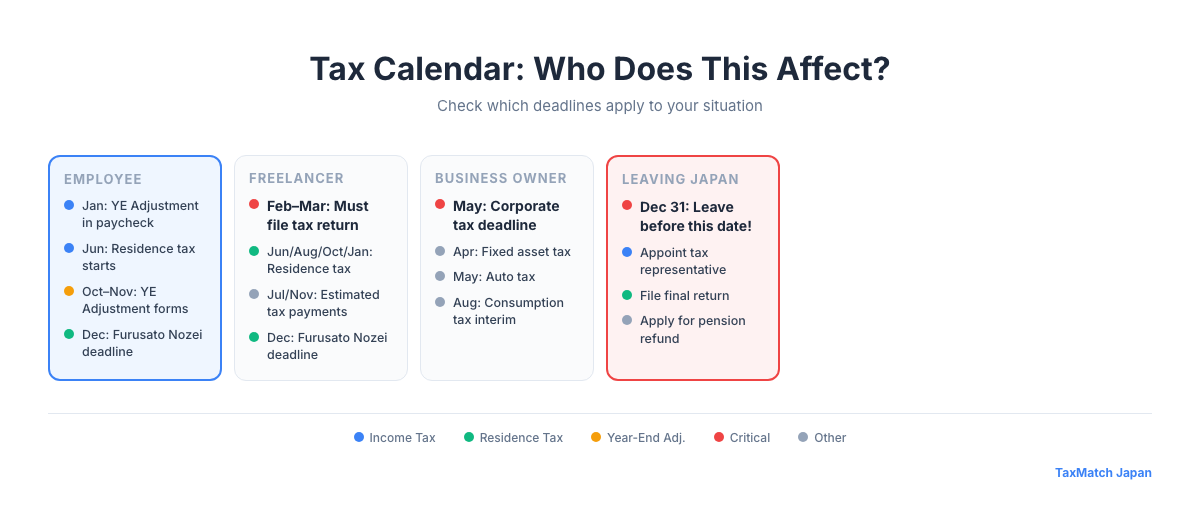
Tax Calendar: Which deadlines apply to your situation?
Some tax obligations do not follow the monthly calendar. Keep these on your radar throughout the year.
Consumption Tax and the Invoice System
If you run a business in Japan, the Invoice System (インボイス制度) — fully in effect since October 2023 — requires registered businesses to issue qualified invoices. Registration is available year-round. If you are a sole proprietor earning more than 10 million yen annually, you are likely already required to charge and remit consumption tax. See our freelancer tax guide for details.
Quarterly Estimated Tax Payments (Self-Employed)
Self-employed individuals and freelancers with significant income tax liability pay estimated tax (予定納税 / yotei nozei) in installments:
- 1st installment: July 31
- 2nd installment: November 30
These are based on your previous year’s tax return. If your income has dropped, you can apply for a reduction.
Exit Tax Planning
If your total financial assets exceed 100 million yen and you have been a resident of Japan for 5 of the past 10 years, unrealized capital gains may be taxed when you leave Japan. This requires advance planning — ideally six months or more before your departure date. See our exit tax guide for details.
Warning
The exit tax is one of the most complex and high-stakes tax issues facing foreign residents in Japan. If this might apply to you, do not try to navigate it alone.
Make This Calendar Work for You
Print this calendar. Set monthly reminders. Share it with your spouse or business partner. Japan’s tax system rewards preparation and punishes procrastination. The penalties for late filing and late payment add up fast — and as a foreign resident, you may have additional obligations in your home country that overlap with Japanese deadlines.
The single best thing you can do is work with a professional who understands both systems.
Never miss a tax deadline again. Get matched with an English-speaking tax accountant — completely free.
Or message us directly: WhatsApp
Frequently Asked Questions
When is tax filing season in Japan?
The annual income tax filing period (kakutei shinkoku) runs from February 16 to March 15. This is when you file your return for income earned during the previous calendar year. Late filing may result in penalties and interest.
What are the key tax deadlines for foreigners in Japan?
Key deadlines include: income tax filing (February 16 – March 15), consumption tax filing (March 31), individual business tax (August and November installments), and fixed asset tax (quarterly payments varying by municipality). Residence tax is typically paid June through January.
When is residence tax due in Japan?
Residence tax for employees is deducted monthly from June through May of the following year (special collection). Self-employed individuals pay in four installments: June, August, October, and January. The tax is based on the previous year’s income.