
Starting a Business in Japan as a Foreigner: Visa, Tax & Setup Guide (2026)
Japan’s new Business Manager Visa rules require ¥30 million in capital and a full-time employee. Here’s the complete guide to starting a business in Japan as a foreigner — and how to survive both immigration and the tax office.
Setting up a company in Japan? Get matched with a bilingual tax accountant who knows the system.
Incorporating in Japan as a foreigner means navigating two powerful, often conflicting bureaucratic systems simultaneously: the Immigration Services Agency (ISA) and the National Tax Agency (NTA). What immigration wants to see — visible profitability, high salary, employment — is precisely what maximizes your tax bill. Understanding both systems, and the tension between them, is essential for building a sustainable business in Japan.
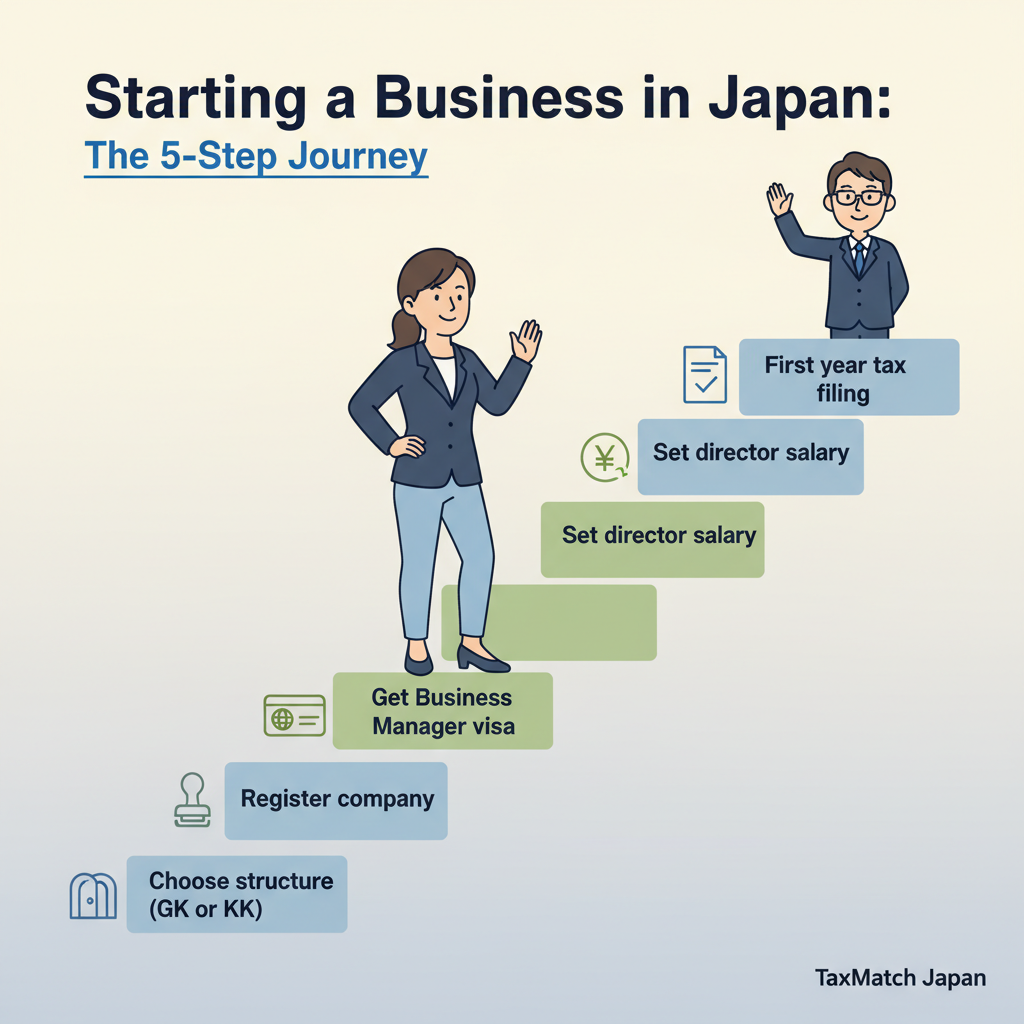
Starting a Business in Japan: The 5-step journey
KK vs GK: Choosing Your Business Structure
Foreign entrepreneurs in Japan typically choose between two company types: the Kabushiki Kaisha (KK, 株式会社) and the Godo Kaisha (GK, 合同会社). Both provide limited liability and are eligible for the Business Manager Visa.
| Feature | Kabushiki Kaisha (KK) | Godo Kaisha (GK) |
|---|---|---|
| Social credibility in Japan | ⭐⭐⭐⭐⭐ Highest | ⭐⭐⭐ Good (growing) |
| Registration tax | Min. ¥150,000 | Min. ¥60,000 |
| Notarization of articles required? | Yes (~¥50,000) | No |
| Total setup cost (approx.) | ¥250,000 – ¥350,000 | ¥110,000 – ¥190,000 |
| Annual publication obligation | Yes (~¥70,000/year) | No |
| External fundraising (VC, IPO) | ✅ Yes | ❌ Not feasible |
| Used by | Most startups, B2B businesses | Amazon Japan, Apple Japan (subsidiaries), small consultancies |
For most foreign entrepreneurs starting a B2B business or needing to build credibility with Japanese partners, KK is recommended. If you are a solo consultant or establishing a subsidiary that doesn’t need external funding, GK can save meaningful setup and ongoing costs.
Business Manager Visa: The 2025 Paradigm Shift
Effective October 16, 2025, Japan’s Immigration Services Agency overhauled the Business Manager Visa requirements. The changes were dramatic and are catching many applicants off guard.
Old Requirements (Pre-October 2025)
- Capital of ¥5 million OR 2 full-time Japanese employees
- Physical office space
- Basic business plan
New Requirements (From October 2025)
- ¥30 million in capital or total traceable investment
- At least 1 full-time employee (Japanese national, Permanent Resident, or Long-Term Resident)
- Japanese language proficiency: JLPT N2 or equivalent (you or the full-time employee)
- Business plan certified by a licensed CPA, SME consultant, or tax accountant
- Physical, dedicated office (virtual offices prohibited)
⚠️ Grace Period for Existing Visa Holders
If you held a Business Manager Visa before October 16, 2025, you have a 3-year grace period (until October 2028) before the new ¥30M capital and employment requirements apply to your renewals. After October 2028, full compliance is mandatory — use this time to scale your business and capital base.
The Catch-22: Banking Without a Visa
To register a company, you need a Japanese bank account to deposit capital. To open a bank account, many banks require a valid visa. To get a visa, you need a company. The standard solution: have a Japanese co-founder or professional service provider temporarily act as representative director, use their existing Japanese bank account to receive capital, complete the registration, then transfer to your own account once the company is established and the visa is obtained.
Tax Obligations from Day One
Corporate Tax Rates
Small and medium enterprises (capital under ¥100 million) benefit from reduced rates:
| Annual Taxable Profit | National Corp. Tax Rate | Effective Rate (incl. all local taxes) |
|---|---|---|
| First ¥8 million | 15% | ~21–24% |
| Over ¥8 million | 23.2% | ~30–34% |
Tax returns must be filed within 2 months of the fiscal year end. Most small companies choose a fiscal year ending in September or October to avoid the congested March period.
The Director Salary Rule: Set It Once and Live With It
This surprises nearly every foreign entrepreneur. Under Japan’s tax law (定期同額給与 rule), director compensation must be:
- Set within the first 3 months of the fiscal year
- Paid in the exact same amount every single month for the entire year
If you pay yourself ¥500,000 in January but ¥800,000 in November because business was good, the ¥300,000 difference is not deductible as a company expense — it’s taxed twice (once as corporate income, once as personal income). Plan your salary carefully before the fiscal year begins.
Social Insurance: Mandatory for Every Company
Even a one-person KK or GK must enroll in Employees’ Health Insurance and Employees’ Pension Insurance. This is non-negotiable — and heavily monitored by the ISA during visa renewals.
Total social insurance cost: approximately 28–30% of gross salary, split 50/50 between employer and employee. For a director paying themselves ¥600,000/month, the company pays ~¥90,000/month in social insurance, and the director’s take-home is reduced by another ~¥90,000.
⚠️ Social Insurance Non-Compliance = Visa Denial
The ISA now directly cross-checks with the Japan Pension Service. Any lapse in social insurance enrollment — even for a single month — can result in visa renewal denial. Past-due premiums can be clawed back for up to 2 years, resulting in enormous retroactive bills.
Municipal Tax: Fixed Even If You Lose Money
Japan’s local inhabitant tax includes a per-capita levy (均等割) that every company must pay regardless of profit or loss. For a small company in most municipalities, this is approximately ¥70,000 per year — billed even in years you have zero revenue.
Consumption Tax and the Invoice System
Historically, companies with under ¥10M in annual sales enjoyed a 2-year consumption tax exemption. The 2023 introduction of Japan’s Invoice System (インボイス制度) changed everything. To issue invoices that allow your B2B clients to claim consumption tax credits, you must register as a qualified invoice issuer — which means voluntarily becoming a consumption tax payer from day one. Most foreign-owned companies serving Japanese businesses now register from incorporation rather than lose clients.
The Hidden Conflict: Visa vs. Tax Optimization
This is the defining challenge for foreign entrepreneurs in Japan, and it’s the area most advisors fail to address properly.
What Immigration Wants to See
- Profitable company (positive operating income)
- Director earning enough salary to live in Japan comfortably
- Consistent tax payments (corporate + individual)
- Full social insurance compliance
What Tax Minimization Tempts You to Do
- Maximize deductions to reduce operating profit toward zero
- Pay yourself a low salary to minimize personal income tax
- Run operating losses in early years to build tax loss carryforwards
The Danger Zone
Companies with consecutive losses, or directors with salaries below ~¥250,000/month (~¥3M/year), trigger strict scrutiny during visa renewal. A company showing 2+ consecutive years of net losses can have its visa renewal denied — regardless of how legally structured those losses are. The ISA views consecutive losses as evidence the business is non-viable and the entrepreneur should not remain in Japan.
Trying to balance tax efficiency with visa requirements?
This is exactly the kind of specialist knowledge TaxMatch Japan advisors provide. Get matched now →
Tax Planning for Foreign Entrepreneurs
Finding the Optimal Director Salary
The “sweet spot” that balances immigration requirements, personal tax efficiency, and social insurance cost for a single director is typically:
- Minimum for visa safety: ¥3M/year (¥250,000/month)
- Recommended for 3-year visa eligibility: ¥5.5M–¥7M/year
- Tax-efficient ceiling: Keep remaining company profit under ¥8M/year to maximize the 15% corporate tax rate on retained earnings
Blue Form Tax Return (青色申告)
File for Blue Form status immediately after incorporation. Benefits include:
- Net operating losses can be carried forward for 10 years (vs. 0 for white form filers)
- No limit on loss offset against future profits (small companies can offset 100% of income)
- Access to various SME-specific tax incentives and deductions
When Should a Sole Proprietor Incorporate?
If you currently operate as a sole proprietor, the break-even point for incorporation is generally when annual profit reaches ¥7–8 million. Below this level, the fixed overhead of a corporation (social insurance, tax accountant fees, municipal tax, setup costs) typically outweighs the corporate tax rate advantage. See our dedicated article for a full comparison table.
Step-by-Step: The Incorporation Process
| Step | Action | Timeline | Typical Cost |
|---|---|---|---|
| 1 | Draft articles of incorporation; engage judicial scrivener (司法書士) | Week 1 | ¥80,000–¥150,000 |
| 2 | Deposit capital to personal bank account; get passbook copy as proof | Week 1–2 | — |
| 3 | KK: Notarize articles of incorporation at public notary (公証役場) | Week 2 | ~¥50,000 |
| 4 | File registration at Legal Affairs Bureau (法務局); pay registration tax | Week 2–3 | ¥150,000 (KK) / ¥60,000 (GK) |
| 5 | Open corporate bank account (digital bank recommended) | Week 3–4 | — |
| 6 | File tax registrations with tax office; file Blue Form application | Within 3 months of incorporation | — |
| 7 | Register for social insurance with pension office | Within 5 days of incorporation | — |
| 8 | Apply for Business Manager Visa (COE application to ISA) | Months 1–3 of operation | ¥100,000–¥200,000 (lawyer fees) |
From decision to operational company with a visa: plan for 4–8 months.
Common Mistakes Foreign Entrepreneurs Make
1. Setting Director Salary Too Low (Visa Risk)
A director salary of ¥100,000/month might minimize taxes but will almost certainly trigger immigration concern during renewal. Set salary at a level that reflects a livable income in Japan.
2. Ignoring Social Insurance (Catastrophic Error)
“It’s just me, so it doesn’t apply” — wrong. Every KK and GK must enroll in Employees’ Insurance from day one. Two years of uncollected premiums can equal millions of yen in retroactive charges plus penalties.
3. Using a Virtual Office (New Rule Violation)
Under the 2025 reforms, virtual offices explicitly do not satisfy the Business Manager Visa office requirement. You need a physical, dedicated commercial space with your company name on it.
4. Showing Losses for Multiple Years
Operating at a loss is a valid tax strategy — but the ISA becomes extremely concerned after year two. Have a certified business improvement plan ready if your business shows a loss. Never let the balance sheet slide into insolvency (liabilities exceeding assets) without an immediate capital injection plan.
📝 Summary: Starting a Business in Japan as a Foreigner
- New rules require ¥30M capital + 1 full-time local employee for Business Manager Visa (from Oct 2025)
- KK recommended for B2B credibility; GK for solo consultants or subsidiaries
- Director salary must be set at start of fiscal year and cannot change mid-year
- Social insurance (28-30% of salary) is mandatory for every corporation, regardless of size
- Balance tax minimization against visa renewal requirements — consecutive losses endanger your stay
- Total setup time: 4–8 months from decision to operating company with visa
Ready to set up your company in Japan?
TaxMatch Japan connects you with bilingual tax accountants who understand both immigration and corporate tax — free service for the entrepreneur.
Or contact us on LINE
This article is for informational purposes only and does not constitute legal or tax advice. Business Manager Visa requirements and tax laws change frequently. Consult a qualified tax accountant (zeirishi) and immigration specialist for personalized guidance.
Frequently Asked Questions
How much capital do I need to start a business in Japan?
The standard requirement for a Business Manager Visa is ¥5 million in capital investment or employing 2+ full-time residents. For company registration itself, a GK can be set up with as little as ¥1, but immigration requires the higher threshold.
Can foreigners start a business in Japan?
Yes. Foreigners can establish and own companies in Japan. You need a Business Manager Visa, a registered office, and proper company registration. The process typically takes 2–4 months.
What is the difference between GK and KK in Japan?
A GK (Godo Kaisha / LLC equivalent) is cheaper and simpler to set up. A KK (Kabushiki Kaisha / corporation) carries more prestige and is better for raising external investment, but costs more to establish.
What taxes does a foreign business owner pay in Japan?
Corporate tax (effective rate ~30–34%), consumption tax (10% if revenue exceeds ¥10 million), personal income tax on salary/dividends, and resident tax.