
How Much Does a Tax Accountant Cost in Japan? Pricing Guide for Foreigners (2026)
The most transparent, data-driven guide to tax accountant pricing in Japan — because “contact us for a quote” shouldn’t be the only answer available in English.
Know the fair price before you commit. Get matched with a vetted, bilingual tax accountant — free.
If you’ve ever Googled “tax accountant fees Japan” in English, you’ve likely found nothing but vague blog posts and “request a custom quote” buttons. Meanwhile, Japanese-language platforms like Zeirishi.com publish detailed, standardized fee tables that let domestic clients price-shop with full transparency.
This guide closes that gap. We’ve compiled pricing data from published firm fee schedules, Reddit community reports (r/JapanFinance, r/japanlife), and industry surveys to give you the most comprehensive English-language reference on what tax services actually cost in Japan — and how to avoid overpaying.
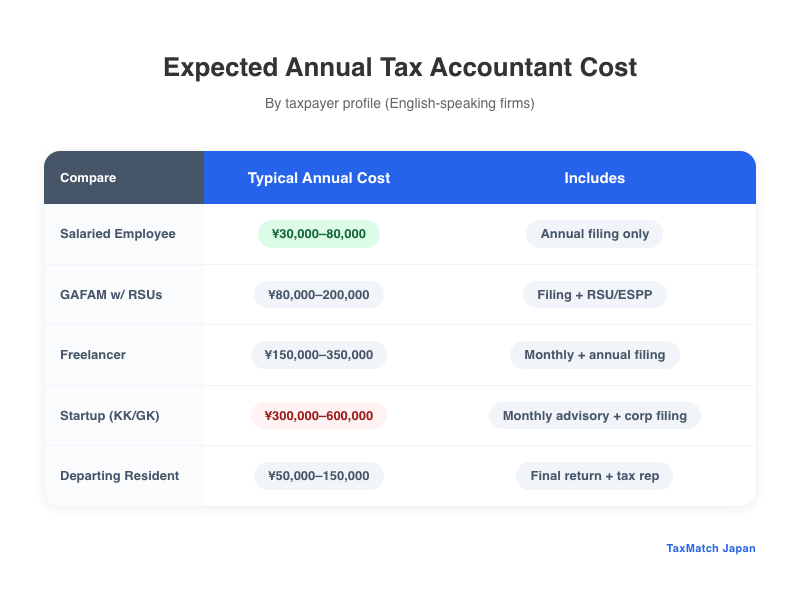
Expected annual cost by taxpayer profile
Quick Summary: What You’ll Pay
| Service | Japanese-Only Firm | English-Speaking Firm | Language Premium |
|---|---|---|---|
| Tax return (salary only) | ¥50,000 – ¥150,000 | ¥150,000 – ¥300,000 | +100–150% |
| Tax return (salary + RSU) | ~¥170,000 | ¥250,000 – ¥300,000 | +50–75% |
| Tax return (freelancer) | ¥50,000 – ¥250,000 | ¥150,000 – ¥500,000 | +100% |
| Corporate retainer (monthly) | ¥20,000 – ¥50,000 | ¥50,000 – ¥150,000 | +100–200% |
| Spot consultation | ¥10,000 – ¥25,000/hr | ¥30,000 – ¥55,000/50min | +100–120% |
| Company setup (GK) | ¥90,000 – ¥160,000 (statutory fees dominate) | — | |
| Company setup (KK) | ¥227,000 – ¥400,000 (statutory fees dominate) | — | |
All fees shown are tax-exclusive (zeinuki). Add 10% consumption tax to get the actual invoice amount. See “Hidden Costs” below.
1. Individual Tax Return Fees
Salary Only (Simple Return)
Most salaried employees in Japan don’t need to file at all — your employer handles everything through year-end adjustment (nenmatsu-chosei). However, you’ll need a personal filing if:
- Your annual salary exceeds ¥20 million
- You have side income above ¥200,000
- You want to claim medical expense or furusato nozei deductions
- You changed employers mid-year
| Firm Type | Fee Range | What’s Included |
|---|---|---|
| Big Four affiliate | ¥500,000 – ¥1,500,000+ | Full risk management, treaty analysis. Overkill for simple returns. |
| English-speaking boutique | ¥150,000 – ¥300,000 | Bilingual consultation, standard deductions, e-Tax filing. |
| Local zeirishi (Japanese only) | ¥50,000 – ¥150,000 | Same quality service — just requires Japanese communication. |
| Self-filing + interpreter | ¥20,000 – ¥60,000 | Maximum savings for straightforward situations. |
Salary + RSU / ESPP (Stock Compensation)
This is where fees jump significantly. RSUs from companies like Google, Amazon, Meta, or Microsoft require your accountant to:
- Calculate fair market value at each vesting date using the TTM exchange rate
- Apply Japan’s moving average method for cost basis across multiple tranches
- Separate Japan-source vs. foreign-source income for proration
- Process foreign tax credits if applicable
Typical quote for RSU filing at an English-speaking firm:
Base fee ~¥151,800 + RSU/stock option surcharge ~¥77,000 = ¥228,800 – ¥300,000 total
Compare: A Japanese-speaking expat on Reddit reported paying ~¥170,000 for a similarly complex return with RSUs and US investments — a 50–75% difference.
Freelancer / Sole Proprietor
Fees scale with your revenue bracket and the state of your bookkeeping. Maintaining a Blue Return (aoiro shinkoku) for the ¥650,000 special deduction requires double-entry bookkeeping — which is exactly what you’re paying your accountant to handle.
| Annual Revenue | Local Firm (Japanese) | English-Speaking Firm |
|---|---|---|
| Under ¥5M | ¥50,000 – ¥100,000 | ¥150,000 – ¥200,000 |
| ¥5M – ¥15M | ¥100,000 – ¥150,000 | ¥200,000 – ¥350,000 |
| ¥15M – ¥30M | ¥150,000 – ¥250,000 | ¥300,000 – ¥500,000 |
Warning: If your records are a mess and the accountant must reconstruct a year of chaotic finances, expect substantial hourly bookkeeping surcharges on top of these figures.
Crypto / Capital Gains Add-On
Cryptocurrency gains are classified as miscellaneous income in Japan and taxed at progressive rates up to 55%. The 2026 tax reform proposes a flat 20.315% rate for specified crypto assets, but the historical transaction tracking remains labor-intensive.
| Number of Transactions | Add-On Fee |
|---|---|
| 1 – 10 | ¥33,000 |
| 11 – 50 | ¥55,000 |
| 51 – 200 | ¥99,000 |
| 201+ | Custom estimate (often ¥150,000+) |
2. Corporate & Business Fees
Monthly Corporate Retainer
The standard model in Japan is monthly retainer (komonryo) + year-end settlement fee (kessanryo). The monthly retainer covers routine advisory, bookkeeping oversight, and withholding tax management.
| Firm Type | Monthly Fee | Typical Client Profile |
|---|---|---|
| Local zeirishi (Japanese) | ¥20,000 – ¥50,000 | Domestic SMEs, up to ¥300M revenue |
| English-speaking boutique | ¥50,000 – ¥150,000 | Foreign-founded startups, branch offices |
| Startup-focused (e.g., “Pocket CFO” plans) | ¥11,000 – ¥33,000 | Early-stage, minimal transactions |
The Year-End Settlement Fee Trap (kessanryo)
This is the single biggest surprise for foreign business owners. The kessanryo — covering the labor of closing your books and filing corporate tax returns — is typically 4 to 6 times your monthly retainer.
Example: A monthly retainer of ¥50,000 means a year-end invoice of ¥200,000 – ¥300,000. Your true annual cost is not ¥600,000 — it’s ¥800,000 – ¥900,000.
Always ask upfront: “What is the kessanryo, and is it included in the monthly quote?”
Company Incorporation
Setting up a legal entity in Japan involves statutory government fees (non-negotiable) plus professional service charges. Note: the actual registration filing must be done by a judicial scrivener (shihoshoshi), not a tax accountant.
| Entity Type | Registration Tax | Scrivener Fee | Total Setup Cost |
|---|---|---|---|
| Godo Kaisha (GK) — LLC equivalent | ¥60,000 minimum | ¥30,000 – ¥100,000 | ¥90,000 – ¥160,000 |
| Kabushiki Kaisha (KK) — Corp equivalent | ¥150,000 minimum | ¥77,000 – ¥200,000 | ¥227,000 – ¥400,000 |
These costs exclude share capital. If you need a Business Manager Visa, the immigration bureau typically expects ¥5M+ in capitalization — see our Business Setup & Visa Guide.
Payroll & Social Insurance Outsourcing
Outsourcing payroll to a bilingual firm typically costs a baseline of ¥30,000 – ¥33,000/month for the first few employees, plus ¥2,000 – ¥5,000 per additional employee. Starting April 2026, the new Child Rearing Premium (0.23% of salary, split employer/employee) adds another line item to process.
Year-End Tax Adjustment (Nenmatsu-Chosei)
If you have employees, this mandatory December process is a separate billing event: roughly ¥20,000 base fee + ¥5,000 per employee at bilingual firms.
Consumption Tax (JCT) Filing
| Filing Type | Local Firm | Bilingual Firm |
|---|---|---|
| General calculation method | ¥68,000+ | ~¥110,000 |
| Simplified method (kani kazei) | ¥35,000+ | ~¥55,000 |
Note: The Qualified Invoice System’s 80% transitional deduction steps down to 70% in October 2026, increasing bookkeeping complexity.
3. Departure & Special Situation Fees
Tax Representative (Nozei-Kanrinin)
If you’re leaving Japan permanently but still have tax obligations (rental income, final return filing), you must appoint a domestic tax representative. Bilingual firms charge ¥44,000 – ¥100,000 as a base fee for this service.
Pension Lump-Sum Withdrawal Tax Refund
When non-Japanese nationals leave Japan after 6+ months of pension contributions, the 20.42% withheld on the lump-sum withdrawal can be recovered. This service is uniquely commoditized:
| Fee Model | Cost |
|---|---|
| Success fee (most common) | 12.5% – 25% of the refunded tax amount |
| Fixed fee (small payouts) | ¥30,000 (payout under ¥1.8M) / ¥40,000 (up to ¥2.8M) |
This is one of the rare cases where you pay nothing upfront — the firm deducts its fee from the refund before sending you the balance.
Exit Tax Consultation
Japan’s Exit Tax applies a 15.315% capital gains tax on unrealized gains for individuals with financial assets exceeding ¥100M who have lived in Japan for 5+ of the past 10 years.
- Initial advisory consultation: ¥100,000+
- Payment deferral documentation: ¥200,000+
Inheritance & Gift Tax
Japan has the highest top inheritance tax rate among OECD nations at 55%. Foreign permanent residents are taxed on worldwide inheritance.
| Estate Value | Bilingual Firm Fee | Big Four Approach |
|---|---|---|
| Under ¥100M | ¥300,000 – ¥500,000 | Rarely engaged |
| ¥100M – ¥200M | ¥800,000 – ¥1,200,000 | 1.0% – 2.0% of estate |
| ¥200M – ¥500M | ¥1,600,000 – ¥3,000,000 | Cross-border treaty optimization |
Spot Consultation & Treaty Application
| Service | Japanese-Only Firm | English-Speaking Firm |
|---|---|---|
| Spot consultation (per session) | ¥10,000 – ¥25,000/hr | ¥30,000 – ¥55,000/50min |
| Tax treaty application / FTC optimization | ¥30,000 – ¥80,000 | ¥150,000+ |
4. The “English Premium” — Why You Pay 50–150% More
This is the elephant in the room. If you need English communication, you will pay significantly more — not because the tax work is harder, but because the supply of bilingual, internationally experienced zeirishi is extremely limited.
Real-World Examples from the Community
Corporate retainer: Japanese business owners report paying ~¥15,000/month + ¥100,000 year-end fee for businesses doing ¥200–300M in revenue. A foreign founder with only ¥20–30M revenue reported paying ¥1,000,000 halfway through the year at an English-speaking firm.
Individual return: A complex return with US investments, trusts, and RSUs costs ~¥170,000 through a Japanese-only firm. The same profile at an English boutique: ¥250,000–¥300,000.
Basic salary filing: English-speaking accountants in regional areas (e.g., Yokosuka) quote baseline minimums of ¥100,000 even for straightforward calculations.
What Drives the Premium
- Supply scarcity: Of tens of thousands of registered zeirishi, only a tiny fraction speak professional-level English
- International expertise: Knowledge of FATCA, foreign trusts, RSU proration, and tax treaties is highly specialized
- Translation overhead: Processing foreign brokerage statements, K-1s, and property documents in English
- Information asymmetry: Foreigners can’t easily price-shop since Japanese fee data isn’t accessible to them
5. Hidden Costs & Common Surprises
These are the charges that cause “sticker shock” — the gap between the quoted price and the actual invoice.
1. Consumption Tax (10%) on Top of Quoted Fees
In Japan, professional service quotes are almost always tax-exclusive (zeinuki). A ¥300,000 quote becomes a ¥330,000 invoice. Always ask: “Is this zeikomi (tax-inclusive) or zeinuki (tax-exclusive)?”
2. The Year-End Settlement Fee (Kessanryo)
As detailed above, this is 4–6x your monthly retainer. Many foreign founders discover this only when the invoice arrives in January.
3. Per-Receipt Processing Charges
If you hand over a box of raw medical receipts, some firms charge ¥440 per individual receipt for manual processing. Fifty receipts = ¥22,000 in fees you didn’t expect.
4. Add-On Charges per Income Category
The base fee covers basic salary income. Each additional income type — overseas assets, rental income, capital gains, RSUs — adds ¥44,000 – ¥77,000 per category.
5. New Client Registration Fee
Some bilingual firms charge ¥50,000 – ¥88,000 as an onboarding fee — sometimes just for a 20-minute introductory meeting and file setup.
6. Document Translation Costs
Foreign brokerage statements, property appraisals, and corporate documents in English cannot be directly imported into Japanese tax software. Firms may charge separately for internal translation labor.
7. Rush Fees
Submitting documents within a month of the March 15 deadline triggers significant surcharges. Plus, late filing itself incurs NTA penalties of 5–20% plus daily interest (entaizei).
6. How to Reduce Your Tax Accountant Costs
Strategy 1: The “Interpreter Arbitrage”
This is the single most effective cost-cutting strategy. Instead of paying the full English premium, separate the expertise from the language:
English boutique firm: ¥300,000
Local Japanese zeirishi (¥100,000) + business interpreter (3 sessions × ¥20,000/hr = ¥60,000): ¥160,000
Savings: ¥140,000 (47% reduction)
This works especially well in Osaka, Kyoto, and other areas outside central Tokyo where domestic rates are lower.
Strategy 2: Use Cloud Accounting Software
Maintaining impeccable records in freee or MoneyForward throughout the year dramatically reduces your accountant’s billable hours. If they only need to review and file rather than reconstruct, your fees drop significantly. Both platforms offer browser translation support.
Strategy 3: Self-Prepare Your Documents
Avoid the per-receipt penalty. Organize medical receipts, donation records, and investment summaries into pre-calculated spreadsheets. A clean Excel file eliminates add-on fees.
Strategy 4: Engage in the Off-Season
Accountants are slammed from January through March and charge premium rates. Reaching out in August–October to establish a relationship often yields better rates, more attentive service, and room for negotiation.
Strategy 5: Switch to Spot Consultation
If your tax situation is straightforward, consider maintaining your own records year-round and booking a single spot check (¥30,000–¥55,000) in January before filing. This is dramatically cheaper than a continuous monthly retainer.
Strategy 6: Check Employer-Arranged Services
Large multinationals often have negotiated group rates with accounting firms for foreign staff. Ask your HR department — this can bypass the retail English premium entirely.
7. How Japan Compares Internationally
Is Japan expensive for tax compliance? It depends on where you’re coming from.
| Country | Individual Tax Filing Cost | System Complexity | Notes |
|---|---|---|---|
| Japan (English-speaking firm) | ¥150,000 – ¥300,000 | High | Progressive rates up to 55.9%. Worldwide taxation for residents 5+ years. |
| USA (expat CPA) | $400 – $7,000+ | Very High | Citizenship-based taxation. FBAR, FATCA, Form 5471 for business owners. |
| UK (non-dom accountant) | £650 – £5,000+ | High (increasing) | Non-dom remittance basis abolished 2025/26. Complex restructuring needed. |
| Singapore | SGD 0 – 1,800 | Low | Territorial system. Most expats DIY via IRAS portal. |
| Hong Kong | HKD 3,500 – 11,760 | Very Low | No capital gains tax, no dividend tax, no inheritance tax. |
Key takeaway: Japan is cheaper than the US for most expats (especially those with foreign corporate ownership), roughly comparable to the UK, but significantly more expensive than Singapore and Hong Kong — reflecting Japan’s heavier regulatory burden and worldwide taxation system.
8. Understanding Japanese Fee Structures
Japanese accounting billing works differently from what you may be used to. Here are the six main patterns:
Monthly Retainer + Year-End Fee (Most Common for Businesses)
You pay a fixed monthly fee for ongoing advisory and bookkeeping oversight. Then, at fiscal year-end, a settlement fee of 4–6x the monthly amount covers the intensive work of closing books and filing corporate returns.
Per-Filing Fixed Fee (Common for Individuals)
A base price determined by your gross income, with modular add-ons: +¥88,000 for business income, +¥66,000 for rental property, +¥33,000 for casualty loss claims, etc.
Hourly / Time-Charge
Rare for ongoing compliance. Used mainly for specialized advisory (M&A due diligence, transfer pricing, tax audits). Expect ¥10,000–¥55,000/hour depending on the firm.
Revenue-Based Sliding Scale
Fees rise proportionally with your business revenue, reflecting both increased liability for the accountant and more transaction volume to reconcile.
Success / Contingency Fee
Primarily used for pension lump-sum withdrawal refunds (12.5–25% of refunded amount) and some consumption tax refund scenarios. No upfront cost to you.
Package / Bundle Pricing
Mid-tier firms bundle corporate tax + payroll + social insurance into “one-stop shop” packages — attractive for foreign startups without local admin staff, but at a premium total price.
Not sure what you should be paying?
TaxMatch Japan matches you with vetted, bilingual tax accountants and shows you fee estimates before you commit — completely free. Find your accountant →
Bottom Line: What Should You Expect to Pay?
Here’s a quick reference by profile:
| Your Profile | Expected Annual Cost (English Service) | With Cost Optimization |
|---|---|---|
| Salaried employee, simple return | ¥150,000 – ¥200,000 | ¥50,000 – ¥100,000 (interpreter strategy) |
| GAFAM employee with RSUs | ¥250,000 – ¥350,000 | ¥170,000 – ¥200,000 (interpreter + pre-organized docs) |
| Freelancer (¥5–15M revenue) | ¥200,000 – ¥350,000 | ¥100,000 – ¥180,000 (freee + spot review) |
| Foreign startup (monthly retainer) | ¥800,000 – ¥1,500,000/year | ¥400,000 – ¥700,000 (local firm + interpreter) |
| Departing Japan (full exit package) | ¥200,000 – ¥400,000 | Varies by asset complexity |
The most important thing you can do is know the market rate before you sign. This guide gives you the data to negotiate from a position of knowledge rather than uncertainty.
Ready to find the right accountant at a fair price? TaxMatch Japan is free for clients.
Disclaimer: This article is for informational purposes only and does not constitute tax advice. Fee ranges are based on publicly available data and community reports as of 2026. Actual fees vary by firm and individual circumstances. Always request a detailed written estimate before engaging a tax professional.
Frequently Asked Questions
How much does a tax accountant cost in Japan?
For foreign residents, tax return preparation typically costs ¥100,000–¥300,000 for salary-only returns, ¥200,000–¥350,000 for salary + RSU/stock returns, and ¥150,000–¥500,000 for freelancer returns. Monthly advisory retainers range from ¥50,000–¥150,000.
Are English-speaking tax accountants more expensive in Japan?
Generally yes, by 20–50% compared to Japanese-only firms. The premium reflects the smaller supply of bilingual professionals and the additional complexity of cross-border tax situations.
Can I find a free tax accountant in Japan?
Tax offices (zeimusho) offer free consultations during filing season, but these are in Japanese and limited in scope. Our matching service is free — you only pay the accountant directly for their services.